blog
How Can B2B Marketing Automation Streamline Workflows and Lead Nurturing?
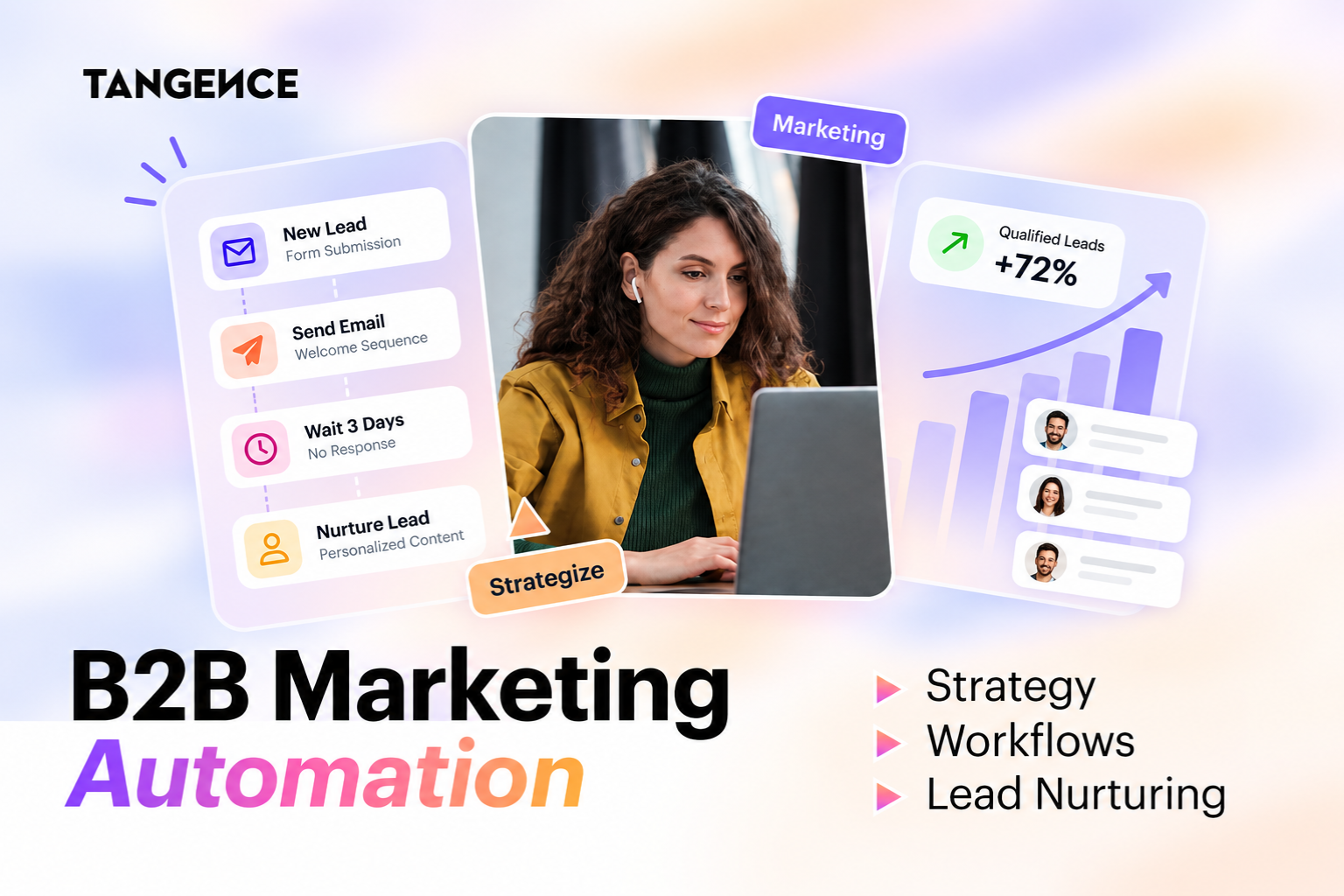
B2B marketing automation has evolved far beyond simple email sequences. In 2026, it’s the operational backbone that connects your CRM, intent data, AI agents, and multi-channel campaigns into a single revenue engine.
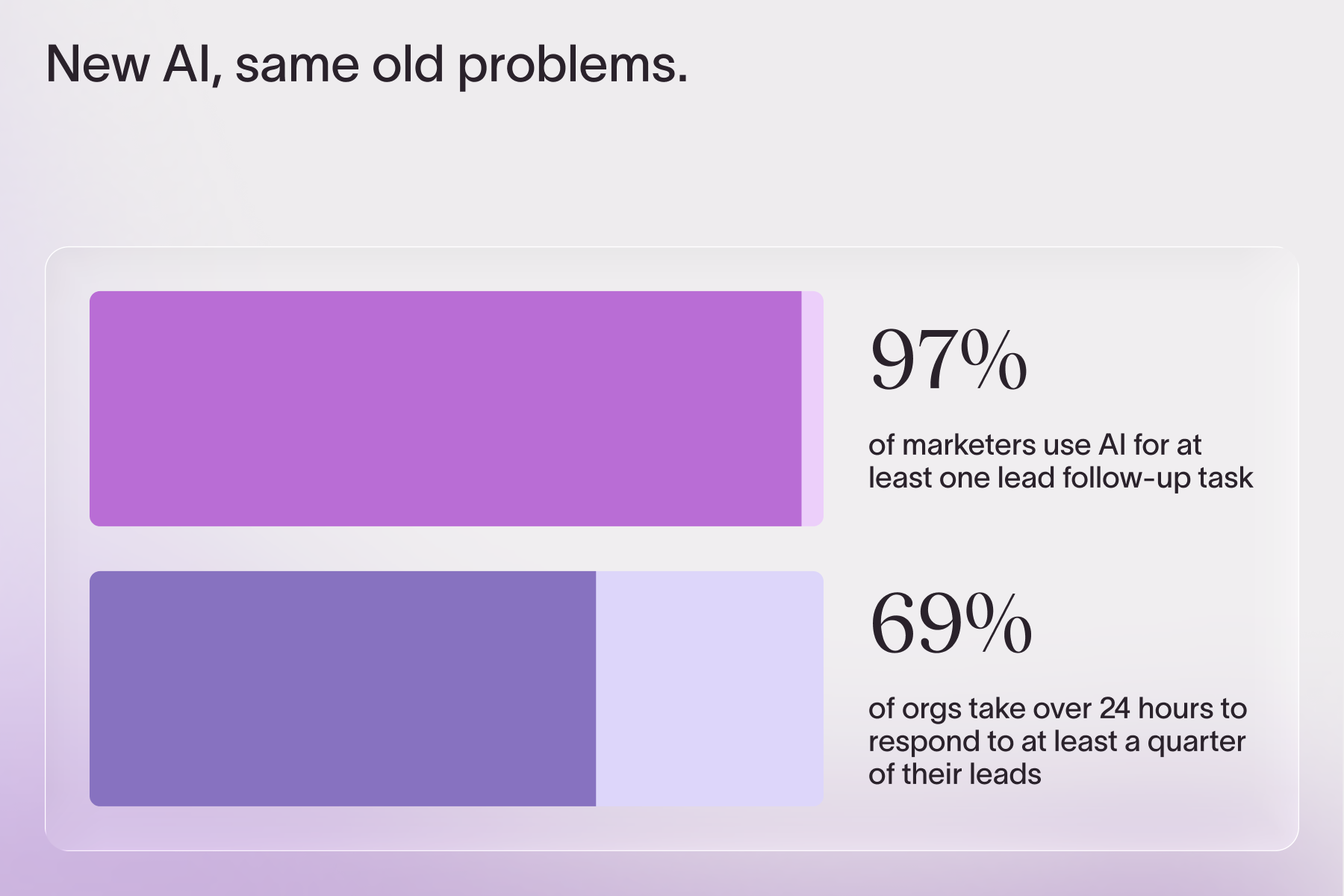
Consider this: 91% of mid-market B2B companies now use marketing automation, yet 69% still take over 24 hours to respond to leads.
These figures highlight how automation is becoming part of everyday marketing operations. For B2B companies, the next step is to connect these activities to lead quality, sales conversations, and revenue.
A successful B2B marketing automation strategy will guarantee efficiency, credibility, and efficacy given the modifications to consumer journey maps and the tightening of privacy regulations.
This guide covers strategy, workflows, and lead nurturing so your automation produces pipeline instead of noise.
What Is B2B Marketing Automation?
B2B marketing automation is the use of software to manage, personalize, and measure marketing activities across the business-to-business buying journey. It helps teams deliver relevant messages based on a prospect’s behavior, interests, role, and stage in the sales process.
For example, when a potential customer downloads a software buying guide, an automated workflow can send a related case study, track further engagement, and notify a sales representative when the prospect shows strong buying intent.
Common uses include:
- Email marketing and follow-up campaigns
- Lead capture and qualification
- Automated lead scoring and routing
- Audience segmentation and personalization
- Webinar registration and post-event follow-ups
- Customer onboarding and retention campaigns
- Campaign reporting and performance analysis
It sits between your CRM, product analytics, and AI-powered channels, coordinating campaigns across the entire customer lifecycle. The focus has expanded from just acquisition to what the industry calls the “bowtie funnel,” managing both new logo acquisition and post-sale expansion.
Why Does B2B Marketing Automation Matter?
B2B buyers often need time to compare vendors, review costs, evaluate risks, and gain approval from different stakeholders. As a result, a single email or sales call rarely completes the journey.
LinkedIn, citing research from Dreamdata, reported that B2B buyers experience an average of 88 touchpoints across four channels and 10 stakeholders before making a purchase.
Although these figures reflect a particular research methodology rather than every B2B buying journey, they illustrate why coordinated communication matters.
It Keeps Follow-Ups Consistent
Manual follow-ups can become difficult when a team manages hundreds of leads. Automation helps ensure that prospects receive the next relevant message without depending on a marketer to remember every task.
It Makes Personalization More Practical
Automation can group prospects by industry, company size, job role, product interest, and engagement. Each group can then receive content that addresses its specific needs.
For instance, a manufacturing company evaluating inventory software may need an implementation guide, while a finance leader may want a cost comparison and return-on-investment analysis.
It Helps Marketing and Sales Work Together
A connected system can share lead activity, qualification scores, and campaign history with sales. Representatives can then prioritize promising prospects and begin conversations with better context.
It Improves Campaign Measurement
Automation platforms can track email engagement, landing-page conversions, lead progression, and campaign performance. When connected to CRM and sales data, these insights can help teams understand which activities contribute to qualified opportunities and revenue.
How to Build a B2B Marketing Automation Strategy
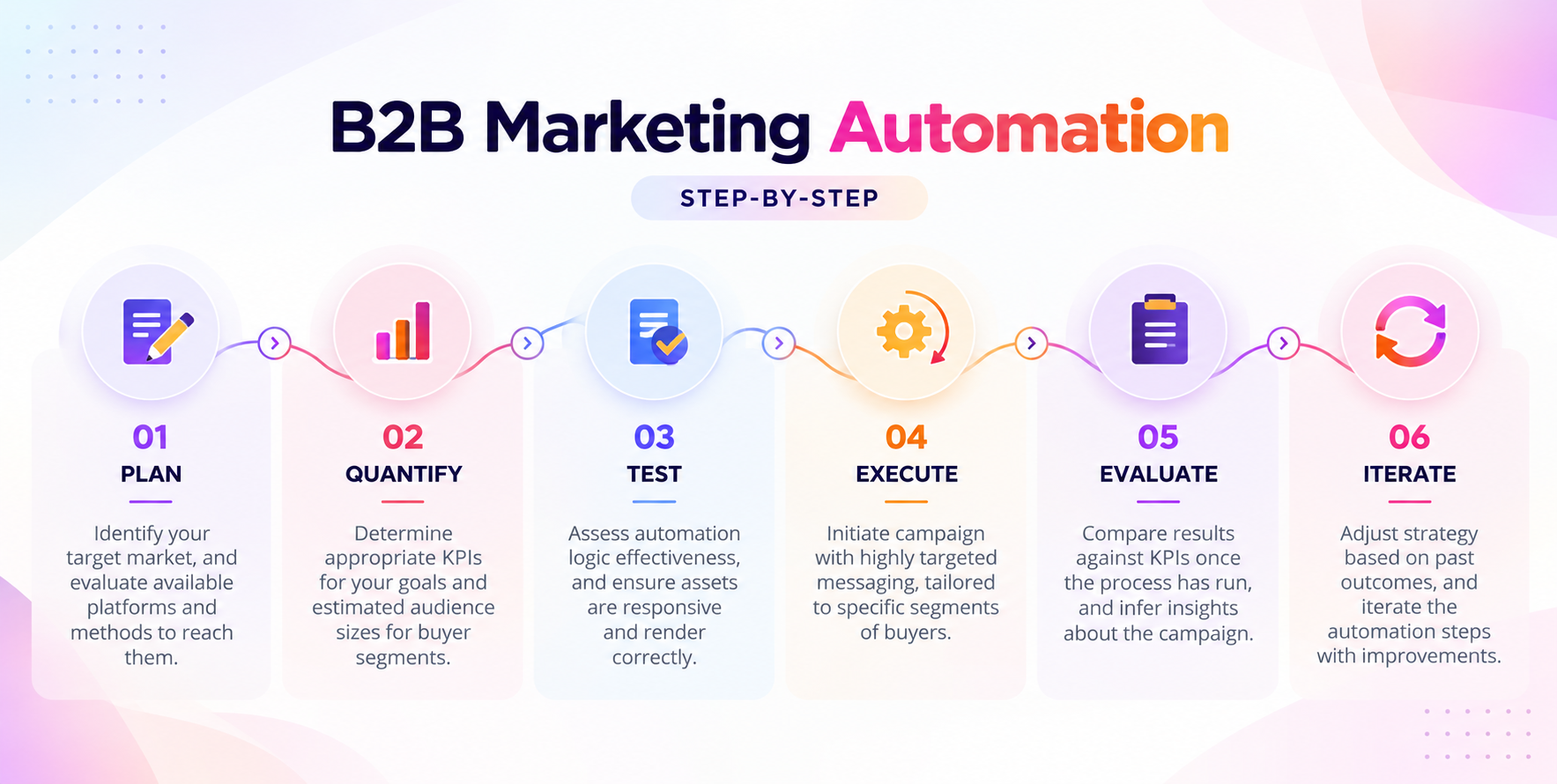
A strong strategy starts with business goals, not software features. Before building workflows, decide which marketing problems you need to solve and how you will measure progress.
1. Define Clear Business Goals
Choose specific outcomes for your automation program. These may include generating more qualified leads, improving demo bookings, shortening sales cycles, or increasing customer retention.
For example, a B2B software company may want to increase the number of marketing-qualified leads that become sales-qualified opportunities. It can use automation to improve follow-up timing, identify high-intent prospects, and track their movement through the funnel.
Set a baseline before launching the campaign. This makes it easier to compare results and identify what needs improvement.
2. Identify Your Ideal Customer Profile
Your ideal customer profile (ICP) describes the type of company most likely to benefit from your product or service. Buyer personas add detail about the people involved in the purchase.
Build your targeting around factors such as:
- Industry and company size
- Annual revenue or budget range
- Job title and decision-making role
- Business challenges and goals
- Technology needs and buying intent
A cybersecurity provider, for instance, may target mid-sized financial firms with limited security resources. Its campaign can then focus on risk assessments, compliance guidance, and security evaluation checklists.
3. Map the B2B Buyer Journey
B2B buyers need different information at different stages. Your strategy should reflect those needs instead of pushing every prospect toward a sales call.
Awareness
- The buyer identifies a problem.
- Share educational blogs, industry reports, practical guides, and short videos.
Consideration
- The buyer explores possible solutions.
- Provide case studies, webinars, comparison guides, and product explainers.
Decision
- The buyer evaluates vendors.
- Offer demos, pricing details, implementation plans, and customer evidence.
Retention and expansion
- The customer looks for continued value.
- Send onboarding tips, product education, renewal reminders, and relevant upgrade information.
A well-planned B2B content marketing strategy helps align each asset with the buyer’s needs at every stage.
4. Choose the Right Automation Platform
Select a platform based on your workflows, team size, integration needs, and reporting requirements. Popular options include HubSpot, Salesforce Marketing Cloud, Adobe Marketo Engage, and ActiveCampaign.
Compare platforms using these criteria:
- CRM integration and data synchronization
- Workflow building and lead scoring
- Segmentation and personalization
- Campaign analytics and attribution
- Consent management and access controls
- Ease of use, support, and total cost
Avoid paying for advanced features your team cannot use. A simple, well-managed setup often provides more value than a complex platform with poorly designed workflows.
5. Align Marketing and Sales Teams
Automation works best when both teams agree on lead qualification, follow-up timing, and ownership.
Define what makes a lead ready for sales. Document how quickly sales representatives should respond, what information they need, and when a lead should return to marketing for further nurturing. This shared process reduces confusion and helps teams measure the same outcomes.
Essential B2B Marketing Automation Workflows
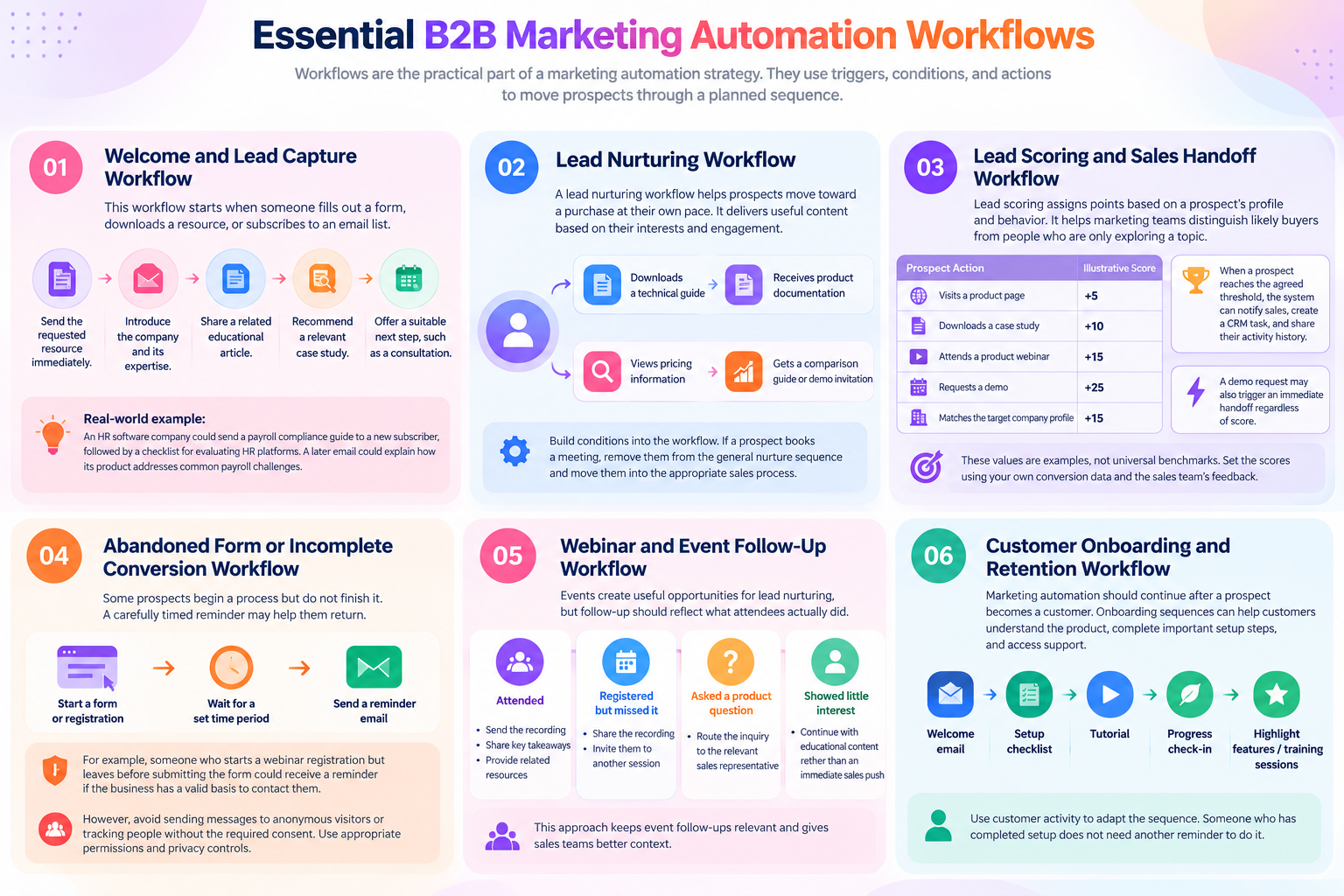
Workflows are the practical part of a marketing automation strategy. They use triggers, conditions, and actions to move prospects through a planned sequence.
1. Welcome and Lead Capture Workflow
This workflow starts when someone fills out a form, downloads a resource, or subscribes to an email list.
A useful sequence might include:
- Send the requested resource immediately.
- Introduce the company and its expertise.
- Share a related educational article.
- Recommend a relevant case study.
- Offer a suitable next step, such as a consultation.
Real-world example: An HR software company could send a payroll compliance guide to a new subscriber, followed by a checklist for evaluating HR platforms. A later email could explain how its product addresses common payroll challenges.
Each message should add value rather than repeat the same sales pitch.
2. Lead Nurturing Workflow
A lead nurturing workflow helps prospects move toward a purchase at their own pace. It delivers useful content based on their interests and engagement.
For example, a prospect who downloads a technical guide may receive product documentation, while someone who views pricing information may receive a comparison guide or a demo invitation.
Build conditions into the workflow. If a prospect books a meeting, remove them from the general nurture sequence and move them into the appropriate sales process.
3. Lead Scoring and Sales Handoff Workflow
Lead scoring assigns points based on a prospect’s profile and behavior. It helps marketing teams distinguish likely buyers from people who are only exploring a topic.
A sample scoring model could look like this:
| Prospect Action | Illustrative Score |
| Visits a product page | +5 |
| Downloads a case study | +10 |
| Attends a product webinar | +15 |
| Requests a demo | +25 |
| Matches the target company profile | +15 |
These values are examples, not universal benchmarks. Set the scores using your own conversion data and the sales team’s feedback.
When a prospect reaches the agreed threshold, the system can notify sales, create a CRM task, and share the prospect’s activity history. A demo request may also trigger an immediate handoff regardless of score.
4. Abandoned Form or Incomplete Conversion Workflow
Some prospects begin a process but do not finish it. A carefully timed reminder may help them return.
For example, someone who starts a webinar registration but leaves before submitting the form could receive a reminder if the business has a valid basis to contact them.
However, avoid sending messages to anonymous visitors or tracking people without the required consent. Use appropriate permissions and privacy controls.
5. Webinar and Event Follow-Up Workflow
Events create useful opportunities for lead nurturing, but follow-up should reflect what attendees actually did.
- Attended: Send the recording, key takeaways, and related resources.
- Registered but missed it: Share the recording or invite them to another session.
- Asked a product question: Route the inquiry to the relevant sales representative.
- Showed little interest: Continue with educational content rather than an immediate sales push.
This approach keeps event follow-ups relevant and gives sales teams better context.
6. Customer Onboarding and Retention Workflow
Marketing automation should continue after a prospect becomes a customer. Onboarding sequences can help customers understand the product, complete important setup steps, and access support.
A software provider might send a welcome email, a setup checklist, a tutorial, and a progress check-in. Later messages can highlight relevant features or invite customers to training sessions.
Use customer activity to adapt the sequence. Someone who has completed setup does not need another reminder to do it.
What Are the Advanced Tactics for 2026 and Beyond
AI agents and the shift to autonomous prospecting
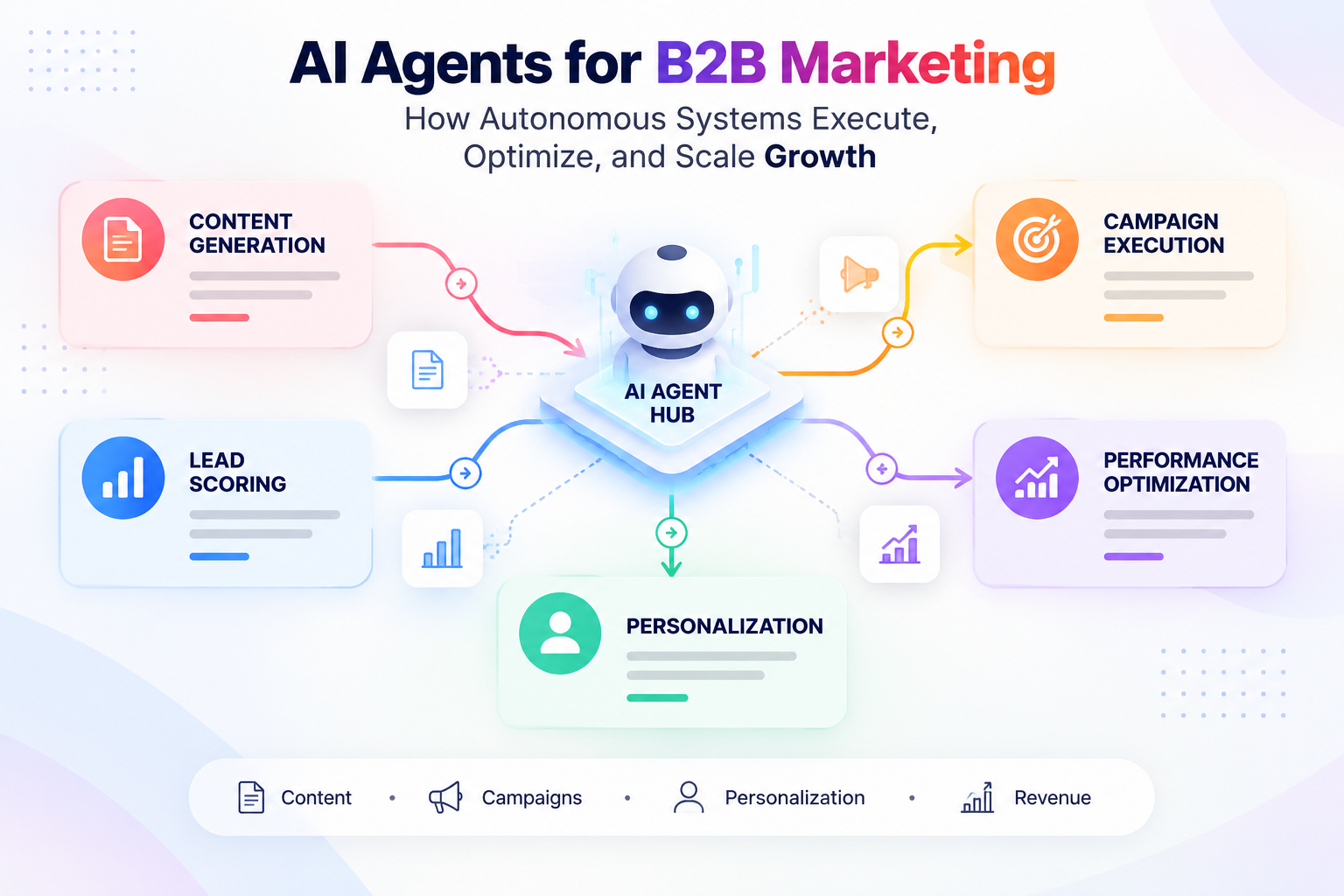
AI agents are replacing the traditional SDR-to-AE handoff with autonomous prospecting, qualification, and nurturing.
Marketing leaders expect AI-driven automation of marketing work to more than double, from 16% in 2026 to 36% by 2028. The opportunity is real, but so are the risks
Teams that get results add AI agents last, after CRM integration and core workflows are solid.
The bowtie funnel: automating expansion revenue
Traditional funnels stop at the deal close. The bowtie extends into post-sale expansion, where 60% of new ARR now lives for top SaaS companies.
Automation for expansion means:
- Usage-drop triggers that fire weeks before an annual health check would catch churn risk.
- Renewal-window sequences starting 90 days out, not 10.
- Expansion triggers on seat count, usage thresholds, or feature adoption.
- Champion departure monitoring: when the buyer who championed your product leaves, renewal risk spikes immediately.
Answer Engine Optimization for B2B content
B2B buyers increasingly research through AI assistants before ever visiting your site. 81% of the B2B customer journey now happens before the sales pipeline.
For your content to get cited by AI engines:
- Lead with direct answers. AI platforms reuse sentences, not context. Rkoof cxsk osxklsu with a complete, standalone answer.
- Use question-based headings that match how buyers phrase queries.
- Ensure AI crawlers can access your content. Check robots.txt for GPTBot, ClaudeBot, and PerplexityBot.
- Update content regularly. Pages updated in the last three months are roughly 3x more likely to be cited
These practices also form part of a broader approach to B2B content marketing, where content structure and discoverability support buyer research across search channels.
How to Measure B2B Marketing Automation Success
The right metrics show whether automation improves the buying journey, not just whether it sends messages.
Track Engagement and Conversion
Monitor email clicks, landing-page conversions, content downloads, webinar attendance, and demo requests. Treat open rates with caution because privacy features and automated email activity can make them unreliable.
Compare results across segments and workflows. A campaign with fewer clicks may still create more qualified opportunities if it reaches the right audience.
Measure Lead Quality and Pipeline Impact
Track marketing-qualified leads (MQLs), sales-qualified leads (SQLs), opportunity creation, and lead-to-customer conversion rates.
Also review the time it takes to move from lead capture to sales qualification. If leads engage with content but rarely progress, check whether the content attracts the wrong audience or whether the qualification rules need adjustment.
Connect Campaigns to Revenue
Use CRM data and suitable attribution methods to understand how marketing interactions relate to opportunities and closed deals. No single attribution model can fully capture every influence on a complex B2B purchase, so document the model and its limits.
Useful business measures include:
- Cost per qualified lead
- Cost per sales opportunity
- Marketing-sourced and marketing-influenced pipeline
- Lead-to-customer conversion rate
- Customer acquisition cost
- Revenue and retention by campaign or segment
Review these measures with sales and finance teams. Their feedback can reveal whether automation is generating genuine demand or simply increasing activity.
For a deeper look at connecting marketing activity to commercial outcomes, learn how to measure B2B content marketing ROI.
Conclusion
B2B marketing automation works when strategy comes first and software second. Start with a clear revenue goal. Align sales and marketing on lead definitions. Clean your data, then build a handful of focused workflows: welcome, scoring, event follow-up, re-engagement, and account triggers.
Nurture with intent. Match content to the buying stage, trigger by behavior, and respond fast. Use AI to save time, but keep real people behind the message. Finally, measure what ties to revenue and review it often.
Need Help Running It? Talk to Tangence
Building and managing effective automation workflows takes time and the right strategy. Tangence helps businesses connect audience segmentation, email campaigns, lead nurturing, CRM integration, and funnel analytics to support their marketing goals. Explore our marketing automation services to build more effective workflows and connect marketing activities with measurable business outcomes.
Frequently Asked Questions
1. What is B2B marketing automation?
B2B marketing automation is software that automates marketing tasks like email sequences, lead scoring, and follow-ups based on buyer behavior. It helps small teams engage many accounts consistently while passing sales-ready leads to the right rep at the right time.
2. How does lead nurturing work in B2B?
Lead nurturing sends relevant content to prospects over time, based on their stage and actions. A buyer might receive an educational guide first, then a case study, then a demo invitation. The goal is to build trust until they are ready to talk to sales.
3. What is a good MQL-to-SQL conversion rate?
Most benchmarks place it between 10% and 20%, with 13% described as a healthy B2B SaaS figure. Your number depends on lead quality, deal size, and how strictly you define an MQL, so compare yourself against your own past performance.
4. How quickly should you follow up with a B2B lead?
Within one hour is the common benchmark. One source reports that following up within the first hour produces a 53% SQL conversion rate. Automated alerts to sales reps make that speed realistic.
5. How does Tangence help with B2B marketing automation?
Tangence specializes in building the strategy and workflow infrastructure that makes automation deliver measurable pipelines. Rather than just implementing tools, Tangence focuses on the operational layer, CRM integration, lead definitions, trigger-based workflows, and the metrics that prove revenue impact.
6. How does Tangence approach lead nurturing differently?
Tangence builds trigger-based workflows that respond to buyer behavior, not calendar schedules. The approach starts with defining what “qualified” actually means, connects the CRM and automation platform in real time, and measures success by pipeline influence rather than email open rates