blog
B2B Content Marketing ROI: How to Measure Content Impact on Revenue

Around 58% to 79% of B2B content teams still can’t prove the ROI of their content marketing. That single statistic explains why so many content budgets get cut before they ever get the chance to prove themselves. B2B content marketing delivers an average return of $3.00 to $7.65 for every $1 spent. Yet most teams still cannot show this number with confidence.
The problem is that content rarely follows a straight line to revenue. A prospect can discover your brand through a blog, return through a product page, download a report months later, and finally enter the sales pipeline after several other touchpoints. By the time the deal closes, it can be difficult to see how much of that journey content actually influenced.
To prove content’s impact on revenue, you need to track the right metrics, map content to the buyer journey, and measure how it contributes to pipeline and closed deals. This guide shows you how to do it.
New to the topic? Start with our guide on B2B Content Marketing: What It Is & How to Do It.
What is Content Marketing ROI?
Content marketing ROI measures how much revenue your content generates relative to what you spend creating and distributing it. It’s expressed as a percentage or ratio, and it turns “content marketing feels like it’s working” into a number leadership can actually evaluate.
The basic formula:
ROI = (Revenue Attributed to Content − Content Investment) / Content Investment × 100
The calculation is useful, but attribution is where content ROI gets complicated. A prospect may read a blog, download a report, return through a product page, and engage with several other channels before becoming a customer. That means content may influence revenue without being the final conversion point.
A reliable ROI assessment therefore needs to account for both revenue directly attributed to content and revenue influenced by content across the buyer journey.
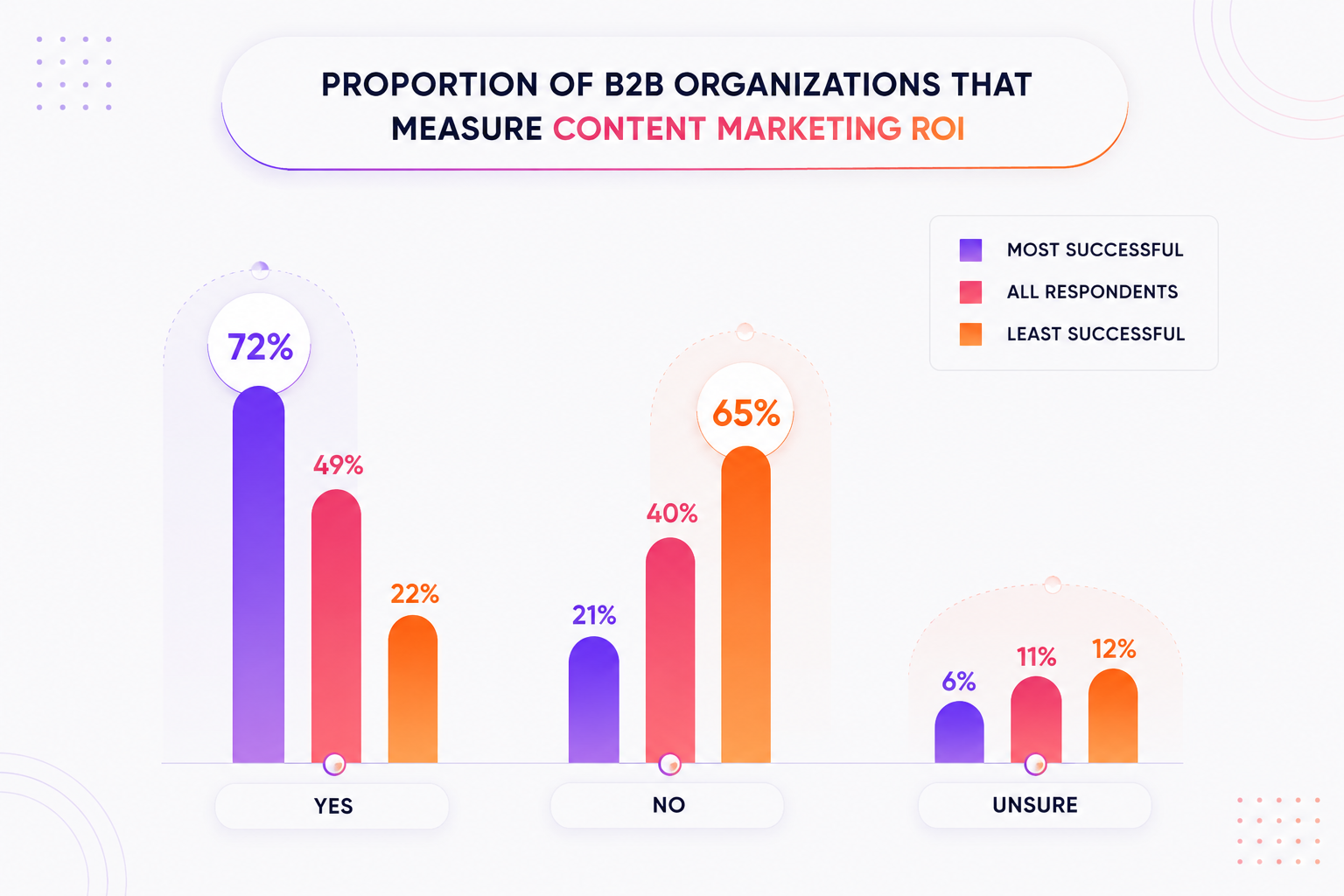
What Are the Key Metrics for B2B Content Marketing ROI?
Content marketing metrics are measurable data points used to evaluate how content performs across the customer journey, from attracting an audience to generating leads and influencing revenue. They help marketers distinguish between content that simply gets attention and content that contributes to meaningful business results.
Key Metrics to Track:
- Conversion Rate: Measures the percentage of users who complete a desired action, such as submitting a form, requesting a demo, or downloading an asset. Its basic formula is
Conversions ÷ Total Visitors or Interactions × 100.
Tracking the revenue generated from those conversions makes it possible to compare the commercial value of different content types.
- Customer Acquisition Cost (CAC): Shows how much it costs to acquire a customer.
CAC = Total Sales & Marketing Costs ÷ Number of New Customers Acquired
For content marketing, include relevant costs such as content production, distribution, paid promotion, and the people involved in creating and managing the program. Comparing CAC across content channels can reveal which ones acquire customers more efficiently.
- Customer Lifetime Value (CLV): Estimates the total revenue a customer generates throughout their relationship with your business.
A simple approach is CLV = Average Purchase Value × Purchase Frequency × Average Customer Lifespan.
CLV becomes especially useful when content attracts customers who continue purchasing or renewing over time.
A useful measurement framework should cover both content performance and financial impact.
For example, traffic can show whether your content is being discovered, but it cannot tell you whether those visitors become customers. Likewise, social shares may indicate strong audience interest without proving that the content generated revenue.
What Are the Best Tools for Measuring Content Marketing ROI?
The best tools for measuring content marketing ROI include Google Analytics 4, HubSpot, Salesforce, Dreamdata, Semrush, and unified intelligence platforms. Each covers a different part of the measurement process, from website engagement and lead generation to attribution, sales conversations, and revenue.
1. Google Analytics 4
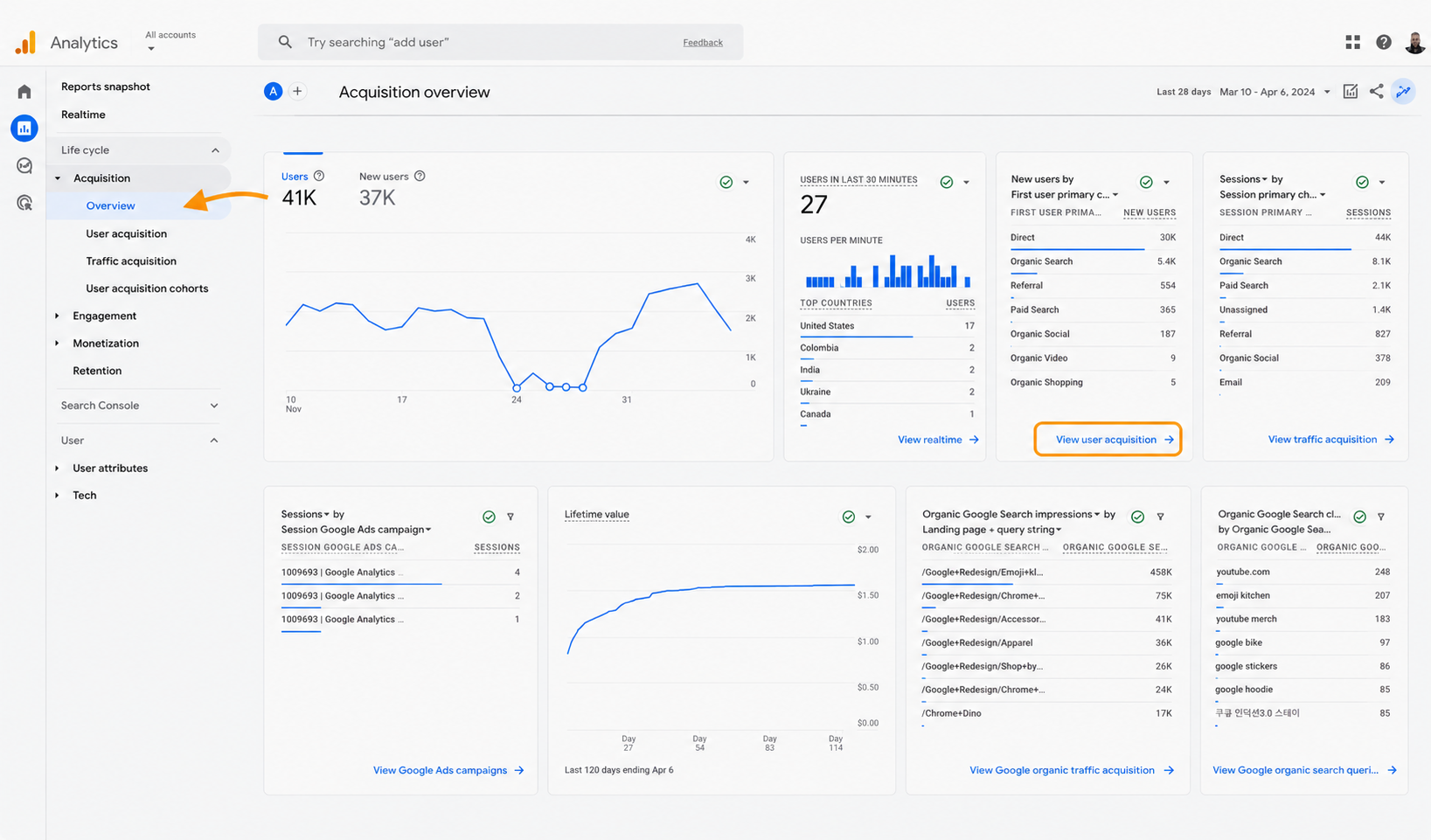
GA4 measures web behavior, event tracking, conversions, and content engagement. It shows which pages people visit, how they engage with content, what actions they take, and where traffic comes from. Its event-based measurement also lets marketers track specific actions, such as video plays, form submissions, downloads, and CTA clicks, rather than relying only on pageviews.
For content ROI, GA4 becomes more useful when these events are assigned business values and connected with conversion data. You can then compare which content drives meaningful actions instead of simply attracting traffic.
Source: GA4 dashboard
2. HubSpot and Salesforce
HubSpot and Salesforce connect content activity with leads, opportunities, customers, and revenue. For example, you can track whether someone who downloaded a report later became a qualified lead or was associated with a closed deal. This helps move measurement beyond traffic and engagement.
3. Dreamdata
Dreamdata focuses on B2B revenue attribution. It connects multiple marketing touchpoints with accounts, opportunities, and revenue. This is valuable when a prospect interacts with several pieces of content before entering or progressing through the sales pipeline.
4. Semrush
Semrush measures organic content performance, including rankings, search visibility, backlinks, and competitors. These metrics help determine whether content is reaching the right audience through search. When combined with CRM data, marketers can see whether organic visibility is producing qualified leads and revenue.
5. Intelligence and Context Layers
A unified data layer combines structured CRM information with unstructured data from sales calls, chats, emails, and support tickets. For example, sales calls from Zoom or Google Meet can reveal when specific content was discussed with prospects. That information can then be compared with won deals, renewals, or expansions to understand content’s influence.
Together, these tools create a clearer path from content engagement, lead, opportunity, and revenue. The goal is not to collect more metrics, but to understand which content is actually contributing to business growth.
How to Measure Content’s Impact on Revenue
To measure content’s impact on revenue, connect content engagement with leads, pipeline, closed deals, and the cost of producing that content. Traffic and downloads can show that people are interested, but revenue measurement requires going one step further: identifying whether those interactions influence buying decisions and contribute to sales.
Here is how you can measure it:
Step 1: Define the Revenue-Related KPIs
Start with the business outcome you want content to influence. Depending on the funnel stage, this could include conversion rate, marketing-qualified leads (MQLs), sales-qualified leads (SQLs), opportunities created, pipeline influenced, customer acquisition cost (CAC), and closed-won revenue.
For B2B content, before defining KPIs, your goal could be to:
- Generate qualified leads from organic search
- Increase demo or consultation requests
- Influence opportunities already in the sales pipeline
- Reduce customer acquisition costs
- Increase revenue from existing customers
- Improve customer lifetime value (CLV)
Step 2: Calculate the Full Cost of Your Content
Your ROI calculation is only as reliable as your cost data. Don’t count just the writer’s fee or the cost of a content agency.
Build a realistic content investment figure that includes:
- Writer, editor, designer, and freelancer costs
- Internal employee time
- Research and production expenses
- SEO, analytics, and content management tools
- Video, webinar, or podcast production
- Paid promotion and distribution
- Content updates and repurposing
For example, if a B2B guide costs $2,000 to produce, $500 to promote, and $300 in associated tools and design, your actual investment is $2,800, not $2,000.
Step 3: Connect Content to the Buyer Journey
Use website analytics and CRM data to follow prospects from their first content interaction through to revenue:
Content interaction, Lead, Qualified lead, Opportunity, Closed deal, Revenue
Track metrics such as:
| Metric | What it tells you |
| Organic traffic & impressions | Whether your content is reaching the audience you want to attract |
| Engagement rate | Whether visitors are actually interacting with and consuming your content |
| Content conversion rate | How effectively content turns visitors into leads or another desired action |
| MQLs/SQLs generated | Whether content is attracting prospects that meet marketing or sales qualification criteria |
| MQL-to-SQL rate | How often content-generated marketing leads progress into sales-qualified leads |
| Pipeline influenced | The value of sales opportunities where content played a role in the buyer journey |
| Win rate | How often content-influenced opportunities ultimately become customers |
| Customer acquisition cost (CAC) | How much investment is required to acquire a customer. |
| Revenue attributed | How much closed revenue is directly associated with content |
| Content-assisted revenue | Revenue from deals where content contributed at some point in the buyer journey |
This is particularly important in B2B, where buying cycles can stretch across months and involve multiple content interactions.
Step 4: Choose an Attribution Model
A prospect may read a blog, download a report, attend a webinar, and then request a demo. Decide how revenue should be credited across those interactions.
- First-touch: Credits the first content interaction.
- Last-touch: Credits the interaction closest to conversion.
- Multi-touch: Shares credit across meaningful interactions.
For complex B2B journeys, multi-touch attribution can provide a more complete picture because it recognizes that several content assets may have contributed to the same opportunity.
Image Source: Customer Think
Step 5: Calculate Content ROI
Once revenue and costs are available, apply the basic formula:
Content Marketing ROI = [(Revenue Attributed to Content − Content Investment) ÷ Content Investment] × 100
For example, if content generates $20,000 in attributed revenue from a $5,000 investment:
ROI = [($20,000 − $5,000) ÷ $5,000] × 100 = 300%
That represents a 300% return, or $4 generated for every $1 invested, including the original dollar.
Step 6: Use the Results to Allocate Budget
The final step is to compare ROI across topics, formats, channels, campaigns, and audience segments. A piece with 50,000 views but little pipeline may be less commercially valuable than a niche report that attracts 500 highly relevant prospects and influences several sales opportunities.
The objective is not simply to calculate one ROI percentage. It is to understand which content contributes to revenue, how much it contributes, and whether the return justifies the investment.
Use ROI Calculator to Plan and Prove Results
Marketing leaders often get asked to justify a budget without any tool that speaks finance’s language. A calculator closes that gap in minutes rather than weeks.
A useful calculator asks for a handful of inputs.
- Content volume and production cost per asset
- Expected traffic and conversion rates at each funnel stage
- Average contract value and average sales cycle length
Feed in historical numbers pulled from GA4 and your CRM. Model a conservative case, an expected case, and an aggressive case side by side. Use the output to frame your next budget request with real numbers instead of instinct.
7 Tips to Increase B2B Content Marketing ROI
B2B content ROI improves when content is built around commercial outcomes, not just publishing volume. These seven strategies can help you turn existing content investments into more qualified demand, stronger pipeline contribution, and better returns.
1. Build Content Around Revenue Opportunities
Instead of choosing topics solely from keyword volume, identify where revenue is already being created or lost.
- Review your highest-value customer segments and industries.
- Identify products or services with the strongest margins or growth targets.
- Create content that addresses the specific problems those buyers are trying to solve.
- Compare pipeline generated from strategic topics with general traffic-focused content.
This shifts content planning from “What can we rank for?” to “What can help us create more valuable opportunities?”
2. Improve Conversion Paths on Existing Traffic
You may not need more visitors to generate more revenue. Sometimes the bigger opportunity is converting the traffic you already have.
Look for high-traffic pages with weak conversion rates and improve their next steps. Add relevant CTAs, product recommendations, templates, consultation offers, or related resources based on the reader’s intent.
For example, a blog attracting buyers researching a specific business problem could link directly to a relevant solution page rather than sending every visitor to a generic contact form.
3. Create Content for High-Value Accounts
Account-based content can make limited content resources work harder.
Identify target accounts that match your ideal customer profile and develop content around their industries, challenges, use cases, or business priorities. This could include industry-specific guides, benchmark reports, personalized landing pages, or executive-level insights.
Measure success through target-account engagement, opportunities created, pipeline value, and revenue, rather than pageviews alone.
4. Use Customer Data to Find Content Gaps
Your existing customers can reveal better content opportunities than keyword research alone.
Analyze:
- Frequently asked questions from customer success teams
- Support tickets and recurring implementation issues
- Questions raised during sales calls
- Product adoption barriers
- Reasons customers choose your solution
- Reasons prospects fail to convert
Turn recurring questions into content. This gives you topics based on real buyer and customer problems, making the resulting assets more commercially relevant.
5. Calculate Content Efficiency, Not Just ROI
Revenue matters, but efficiency shows whether your content operation is becoming more productive.
Track how much content investment is required to generate outcomes such as:
Content Efficiency = Content-Influenced Pipeline ÷ Content Production Cost
You can also compare the cost per MQL, SQL, opportunity, or customer generated by different content formats. If webinars consistently produce fewer leads but significantly more opportunities than blog posts, the numbers can justify shifting resources toward webinars.
6. Build Content Around Product Adoption
Content doesn’t have to stop working once a prospect becomes a customer.
Create onboarding guides, implementation resources, use-case tutorials, advanced playbooks, and best-practice content that help customers get more value from your product or service.
This can support retention, expansion, and upselling while giving marketing another measurable contribution beyond acquisition.
Source: Brafton
7. Set a Content Investment Threshold
Not every piece deserves unlimited time and budget. Establish clear performance thresholds before scaling production.
For example, decide what qualifies as:
- Scale: Consistently generates qualified pipeline or revenue.
- Improve: Shows potential but has weak conversion or engagement.
- Maintain: Provides strategic value but limited direct revenue.
- Retire: Consumes resources without meaningful business impact.
Review these thresholds quarterly and reallocate resources toward content that demonstrates stronger commercial performance.
Conclusion
Content marketing ROI is not about proving that a blog post generated a sale on its own. In B2B, content often influences buyers across multiple touchpoints before an opportunity becomes revenue. The goal is to understand where content creates value, how much it contributes to pipeline and revenue, and whether that return justifies the investment.
Start by connecting content performance with CRM and revenue data, tracking metrics such as conversion rates, qualified leads, pipeline influenced, CAC, attributed revenue, and content-assisted revenue. Then use those insights to invest more in the topics, formats, audiences, and channels that consistently contribute to business growth.
Want to turn your B2B content into a measurable revenue driver? Tangence can help you build a content strategy that connects audience needs with business goals, creates content around high-value opportunities, and measures its contribution to pipeline and revenue. Contact Tangence about building a more ROI-focused B2B content strategy.
FAQs
What is B2B content marketing ROI?
B2B content marketing ROI measures the revenue generated or influenced by content compared with the investment required to create, distribute, and manage it. The basic formula is (Revenue Attributed to Content − Content Investment) ÷ Content Investment × 100.
How do you measure content marketing ROI?
Measure content ROI by connecting content interactions with leads, opportunities, pipeline, closed deals, and content investment. Track metrics such as conversion rate, MQLs and SQLs, pipeline influenced, win rate, CAC, attributed revenue, and content-assisted revenue.
How long does it take to see ROI from B2B content marketing?
B2B content marketing typically takes three to six months to show measurable ROI. For longer sales cycles, track SQLs, opportunities, and pipeline influenced while waiting for closed revenue.
What should I fix first if my current reporting feels scattered?
Pick three to five core KPIs and connect your analytics platform directly to your CRM. Choose one attribution model and stick with it before layering in calculators and AI tools later.
How can you improve B2B content marketing ROI?
Focus content investment on commercial opportunities rather than publishing volume. Improve conversion paths on existing traffic, create content for high-value accounts, use customer data to identify content gaps, measure content efficiency, support product adoption, and set clear performance thresholds for scaling, improving, maintaining, or retiring content.