blog
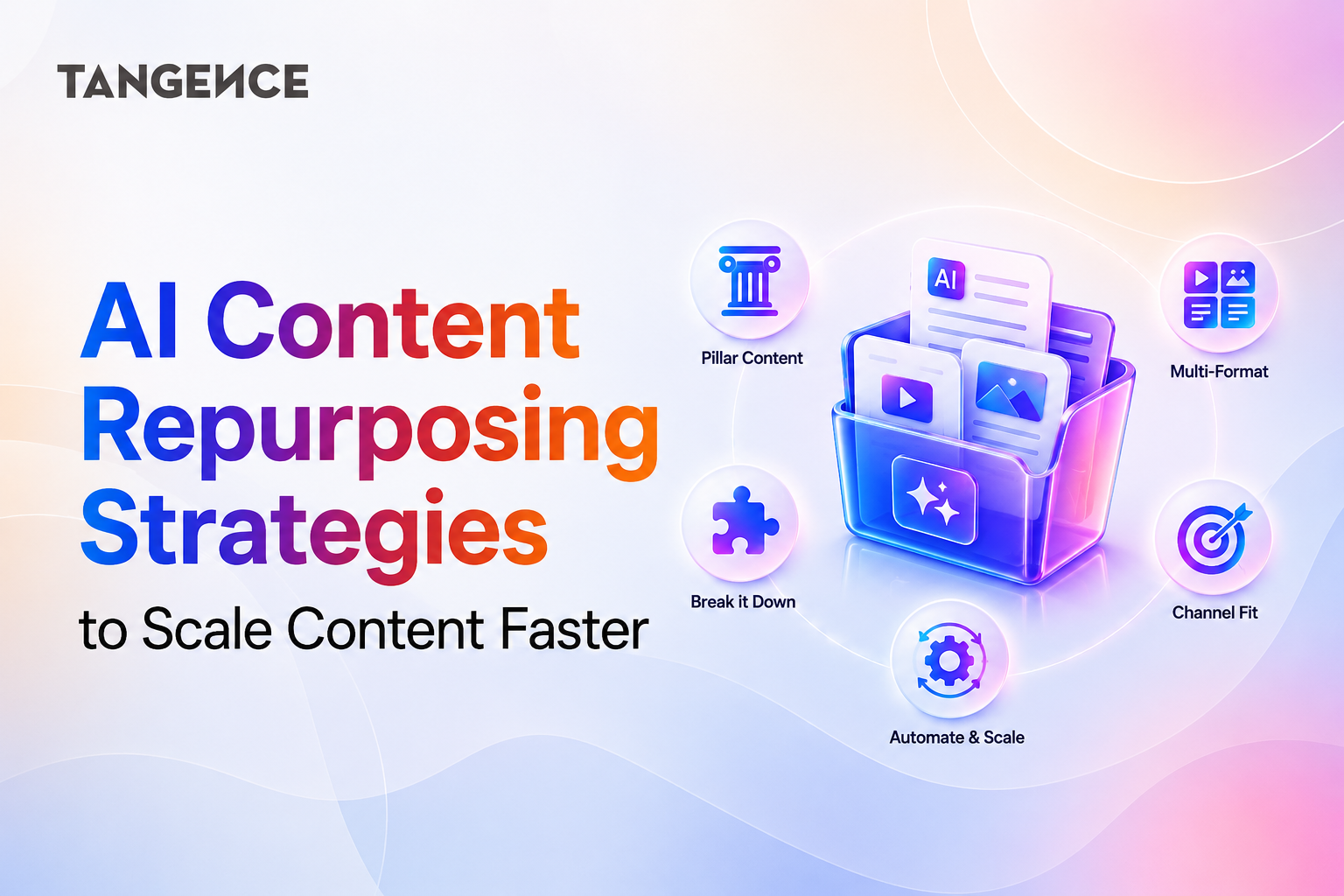
AI Content Repurposing Strategies to Scale Content Faster
Making new content every time needs lots of time. You write a blog, record a podcast, or film a video. Then you share it.
What happened next? Maybe a few hundred people read it. Maybe a few people shared it on social media. But after a few days, that wonderful piece of writing probably slipped down your website feed. It became old news.
But what if you could turn one good piece of content into many pieces? This is called content repurposing. It means taking a blog post and turning it into social media posts, email newsletters, and video clips. You get more from the work you already did.
Now, artificial intelligence is changing how people repurpose content. AI can take a two-hour webinar and pull out the best parts in minutes. It can turn a video interview into a blog post. This helps you share your ideas everywhere without working more hours.
Moreover, companies using AI for content repurposing report 3.7x higher engagement rates and a 40-60% reduction in content production costs.
This guide explains the latest AI content repurposing strategies businesses use in 2026 to repurpose content faster with AI while keeping quality high and maintaining trust with readers.
What is AI Content Repurposing and Why Does It Matter?
AI content repurposing means using artificial intelligence to transform existing content into new formats for different audiences and platforms.
The goal is simple: Create once and distribute many times.
For example:
| Original Content | Repurposed Content |
| Webinar | Short video clips |
| Blog post | LinkedIn carousel |
| Podcast | Twitter thread |
| Research report | Infographic |
| YouTube video | Blog post |
| Case studies | Email sequence |
AI helps automate much of this work.
Instead of manually rewriting content for every platform, marketers use AI to speed up editing, formatting, summarizing, and restructuring.
However, successful AI content repurposing still needs human oversight. Studies on generative AI workflows continue to highlight the importance of human review for accuracy, brand voice, and factual quality.
Modern AI tools can now:
- Summarize long content
- Rewrite content for different platforms
- Turn text into video scripts
- Extract quotes and highlights
- Generate captions
- Create content calendars
- Translate content into multiple languages
AI tools save time by automating tasks like drafting, formatting, and research, cutting production times by up to 40%.
They can listen to audio files and watch videos. They can find the most exciting parts of a speech or summarize a dense report instantly.
Using AI for this job does not mean letting a robot do all your thinking. Instead, AI acts like a super-fast assistant. It handles the boring parts of formatting and summarizing. This leaves you with more time to add your own personal touch and real-world stories.
Related Guide → What Is B2B Content Marketing?
The Core Pillar Strategy: Start with High-Value Assets
You should never ask AI to copy and paste random thoughts. If you put poor information into a machine, you will get poor results out of it. To scale successfully, you must start with a strong “pillar” asset.
A pillar asset is a deep, high-quality piece of work that contains a lot of useful facts. Excellent examples of pillar material include:
- Long-form blog posts: Articles with over 2,000 words that explain a topic completely.
- Webinars and video interviews: Hour-long recordings of experts speaking.
- Whitepapers and research reports: Documents packed with new data and statistics.
- Customer case studies: Real stories of how your product helped someone succeed.
These assets are perfect because they have already proven their value. They contain real facts, unique viewpoints, and deep knowledge. They give the AI plenty of good data to work with.
Read Next → How to Build a B2B Content Marketing Strategy
Step-by-Step AI Workflows for Modern Marketing
Let us explore exactly how to break down your big pillars into smaller, bite-sized pieces using modern tools.
1. From Long Video to Viral Short Clips
Short-form content dominates modern platforms.
TikTok, Instagram Reels, YouTube Shorts, and LinkedIn posts all reward fast and engaging content.
Also, there is a growing demand for AI-powered video workflows because businesses need more short-form media faster than traditional editing can support
According to recent data, demand for AI video creation services increased 66%, alongside a 136% rise in AI automation services.
This is where AI content repurposing creates massive efficiency.
How does it work?
When you upload a long webinar or podcast, the AI analyzes the audio transcript. It looks for moments where the speaker’s voice changes or where they say something highly impactful. The software automatically cuts out a 30-second clip, changes the layout to fit mobile phone screens, and adds bright text captions on top. It even gives the clip a score to predict how popular it might become online
2. Make Your Content Easy for AI to Find
Search engines like Google are now using AI to answer questions. This is called generative engine optimization, or GEO for short. When someone asks a question, AI pulls information from many sources to create one answer.
To get your content included in those answers, you need to write in a way that AI understands easily.
Also, content that plays multiple roles gets cited more often. That means if your blog post works as an explainer, a how-to guide, a comparison, and an FAQ all in one, AI is far more likely to pick it up.
Here are three simple rules for formatting content so AI can read it well:
- Cover topics broadly and deeply. Write about every angle of a subject. Link related pages together.
- Make each section stand alone. Every paragraph or block of text should make sense by itself. AI often pulls small pieces from your page, not the whole thing.
- Start with the answer first. Lead with your main point, then add details. This helps both AI and busy readers get the key idea right away.
These rules also help real people. People scan content. They want clear answers without wading through fluff.
3. Topic Cluster Expansion and Smart Internal Linking
One of the best ways to scale content is by turning a single successful article into a full topic cluster. Instead of relying on one standalone blog post, brands create multiple related articles that connect through internal links. This strategy helps search engines understand your expertise and improves rankings for many keywords at the same time.
A topic cluster usually includes:
- One main pillar page covering a broad topic
- Several supporting articles focused on smaller subtopics
- Strategic internal links connecting all related pages
For example:
| Pillar Topic | Cluster Articles |
| Content Marketing Guide | SEO Basics, Email Marketing Tips, Keyword Research, Blog Promotion |
This structure creates a strong content ecosystem that improves user experience and builds topical authority.
Recent studies show that websites with strong internal linking structures often achieve better crawlability and higher search visibility. Search engines use these links to understand how pages relate to each other and which topics your site covers deeply.
Many large brands use this model successfully. A long guide on digital marketing can support smaller posts about:
- Link building
- On-page SEO
- Content calendars
- Audience targeting
- Blog optimization
Each supporting article links back to the main guide while also connecting with related cluster posts.
To build an effective topic cluster:
- Identify missing subtopics using keyword research tools
- Find long-tail keywords and common user questions
- Create detailed content for each subtopic
- Use keyword-rich anchor text for internal links
- Regularly update the pillar page with new cluster content
This strategy does more than repurpose content. It creates long-term SEO value and helps websites rank for both competitive and niche search terms over time.
Related Guide → How Content Marketing Supports B2B Lead Generation
4. Turn One Webinar into Many Assets
Webinars are great. They are full of useful information. But they are long. Most people do not have time to watch a full hour of video. AI can help you break that long video into small, easy-to-use pieces.
Here is how it works. First, record your webinar. Then use an AI tool to get a full transcript.
From that transcript, you can:
- Pull out the top three questions people asked and turn them into an FAQ
- Find the best quotes and make them into social media posts
- Identify key steps or processes and turn them into a how‑to guide
- Create short video clips (30 to 90 seconds) for TikTok, Instagram Reels, or YouTube Shorts
AI tools can do all of these steps automatically. In fact, nearly 49% of publishers already use AI, and 33.33% specifically for content repurposing.
One key idea is to plan your webinar with repurposing in mind. Write clear titles for each section. Use slides that break down complex ideas. When you design content for reuse, every live session can turn into dozens of smaller assets
5. From Blog Posts to Social Media Snippets
A single deep article can easily feed your social media channels for an entire month. You can use platforms like Tofu or Postiv to scan your text. The AI can pull out five sharp quotes for X (formerly Twitter), create a step-by-step summary for a LinkedIn slideshow carousel, or draft a short script for an Instagram Reel.
Why Micro-Content Wins the Scroll
People browse social networks with short attention spans. They rarely click away from their favorite app to read a full website article. To win their attention, you must bring the value straight to their feed using micro-content.
Using AI to slice your big articles into social snippets offers massive benefits:
- High-velocity publishing: Turn one article into 15 unique social posts in less than 5 minutes.
- Algorithmic favor: Social platforms love native text and image carousels, keeping users on their platform longer.
- Zero creative block: You never have to stare at a blank screen wondering what to post today.
The Repurposing Breakdown
When you feed a 2,000-word pillar article into an AI tool, you can instruct it to output a diversified mix of social assets based on past performance data:
A Real-World Example
Imagine you publish a comprehensive article titled “The Ultimate Guide to Remote Team Management.” Instead of just sharing the link with a boring “Check out our new post” caption, you feed the text into an AI tool with specific instructions.
The software automatically generates a complete social media pack:
- Asset 1 (The LinkedIn Carousel): A slide-by-slide text breakdown. Slide 1 states: “The 3 hidden mistakes killing remote team morale.” Slides 2 through 4 detail the mistakes using simple bullet points, and Slide 5 offers a clear solution.
- Asset 2 (The Hook Script): A short script for an Instagram Reel that starts with an immediate hook: “If your remote team is quiet on Slack, you might have a major problem. “Here is why…”
- Asset 3 (The X Thread): A series of 4 connected, high-impact short statements highlighting key statistics from the article.
Keep Reading → B2B Content Marketing Examples That Drive Results
6. Turning Static Data into High-Impact Infographics
If your pillar content contains rich statistics, case studies, or complex step-by-step frameworks, it is a prime candidate for visual transformation. Tools like Canva AI, Piktochart, or Adobe Firefly can ingest raw text data and help you map out eye-catching visual guides.
The Power of Visual Learning
Human brains process images significantly faster than plain text. When you turn a dense paragraph of statistics into a beautiful infographic, your content becomes much easier to understand and share.
- Massive Shareability: Infographics are shared three times more often on social platforms than any other content type.
- Backlink Generation: Other bloggers love embedding helpful charts into their own articles, which sends valuable SEO authority back to your website.
- Better Accessibility: High-quality visuals allow casual scrollers to digest your core business insights in under ten seconds.
The AI-to-Visual Workflow
You do not need to be a professional graphic designer to create stunning assets. The modern AI workflow makes it incredibly simple:
- Step 1: Copy all the data points, percentages, or steps from your article.
- Step 2: Paste them into an LLM and ask, “Turn these statistics into a wireframe script for a 5-part infographic layout. Keep the titles very short.”
- Step 3: Take the structured layout prompt and drop it into an AI design tool to generate a beautiful, brand-aligned visual template instantly.
Choosing the Right AI Tools
The software market is growing rapidly. You do not need to buy every single app, but you should pick the ones that match your primary medium. Here is a quick guide to top-performing tools:
| Tool Name | Best Used For | Primary Input Type |
| ImagineArt | Automated, multi-format media pipelines | Images, Text, Video |
| Opus Clip | Creating short social media clips from a long video | Long-form Video |
| Cast magic | Turning spoken audio into text notes and summaries | Audio Files |
| Tofu HQ | B2B omnichannel adaptation and persona matching | Text, PDFs, Web Links |
| Pictory | Turning written articles into stock footage videos | Blog URLs, Text Scripts |
How to Make AI Content Pass Detection and Build Trust
Many people worry about using AI because they think it sounds robotic. They are afraid search engines like Google will punish them or that readers will get the “AI ick.” This happens when text feels cold, repetitive, and empty.
To pass AI detectors and keep your readers happy, you must follow the principles of E-E-A-T. This stands for Experience, Expertise, Authoritativeness, and Trustworthiness. AI does not have real-life experiences. You do.
Here is how to mix human wisdom with machine speed to create flawless posts:
Always Use a Human Editor
Never publish text straight out of an AI tool without reading it first. Treat the AI output like a rough first draft. A human should go through the text to fix strange phrases, shorten long sentences, and add emotional warmth.
Inject Your Unique Point of View
AI is trained on public data, which means it usually shares average opinions. To stand out, you need to take a clear side. Share what works in your specific business and what fails miserably. If you disagree with an industry trend, say so!
Add Real-World Examples
A machine cannot tell a story about a difficult client who finally found success. It cannot talk about the mistake your team made last Tuesday and what you learned from it. Adding these real details makes your writing completely unique. No AI detector can flag a story that belongs entirely to you.
Structure for AI Search Engines
People do not just search on Google anymore. They use tools like ChatGPT and Perplexity to get direct answers. To make sure your repurposed material gets picked up by these engines, structure it clearly. Use short paragraphs. Use bulleted lists. Put a quick summary at the very top of your articles so algorithms can scan your ideas instantly.
Conclusion: The Future of Scaling
Technology is moving incredibly fast. AI is no longer a luxury for big corporations; it is basic infrastructure for everyone. The companies that win the attention war are those that learn to work side-by-side with clever tools.
By taking your best ideas and using smart software to spread them across multiple platforms, you save time, protect your creative energy, and connect with more customers than ever before. It is time to stop reinventing the wheel every time you sit down to type.
Ready to get more value from the content you’ve already created? Tangence helps marketing teams build scalable AI-powered content repurposing strategies that improve reach without increasing production workload. Contact us to discuss a strategy tailored to your business.
Read Next → How B2B Content Marketing Attracts High-Quality Leads
FAQs:
1. What is AI content repurposing?
It is using artificial intelligence to transform one primary content piece—like a webinar or blog—into multiple formats for different platforms, saving time and increasing reach.
2. How does AI video repurposing work?
AI software analyzes long-form video transcripts, automatically identifies highly engaging segments, cuts them into short clips, re-frames the layout for mobile, and adds captions.
3. Will search engines penalize AI-repurposed content?
No, if it provides value. Google rewards helpful content. To ensure rankings, a human must edit the text to inject unique viewpoints, real-world experiences, and accurate facts.
4. What tools are best for text-to-social repurposing?
Platforms like Tofu HQ, Postiv, and Typeface are excellent for scanning long-form articles and instantly generating platform-specific LinkedIn carousels, X threads, or short video scripts.
5. How does repurposing improve SEO performance?
It allows you to build comprehensive topic clusters. By linking smaller, repurposed subtopic articles back to a main pillar page, you boost your website’s overall topical authority.