blog
How a Content-Led Approach Improves B2B Marketing
The way B2B buyers make decisions has fundamentally changed. They no longer wait for a sales rep to call them. They research independently, compare vendors quietly, and form strong opinions long before anyone from your team enters the picture. By the time a prospect actually reaches out, they have already read your content or your competitor’s.
That is the reality that makes how a content-led approach improves B2B marketing such a pressing question for modern revenue teams. It is not a trend. It is a structural response to how business buying actually works today. Companies that lead with content are not just generating more leads; they are building the kind of trust and authority that closes bigger deals, shortens sales cycles, and keeps customers longer.
This article breaks it all down: what the approach means, why it works, and how to execute it in a way that delivers real commercial results.
What Does a Content-Led Approach Actually Mean?
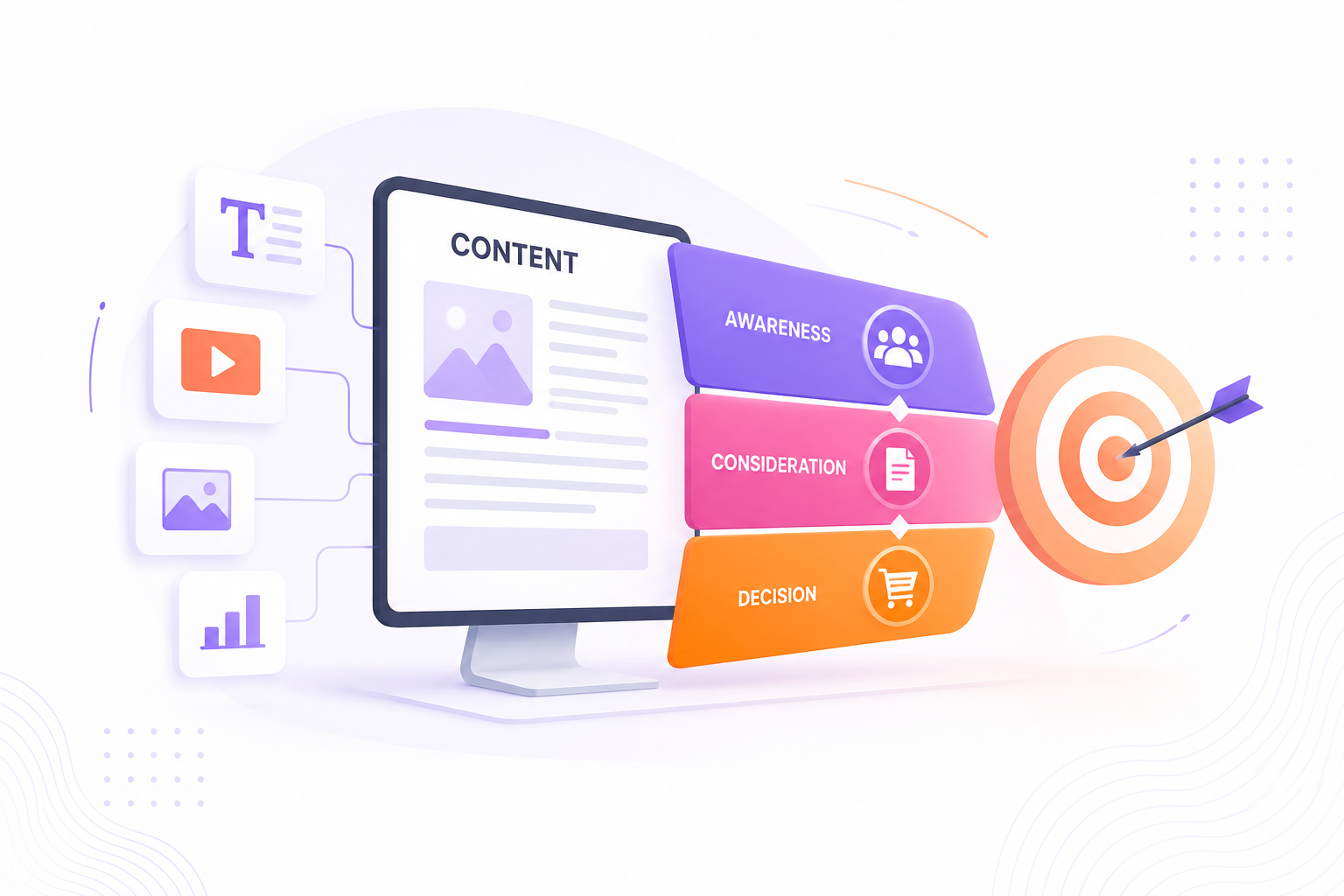
A content-led approach means that content is not a supporting act; it is the main event. Instead of treating blog posts and whitepapers as extras that sit alongside your “real” marketing, you make content the central engine that every other channel feeds into and amplifies. This is how a content-led approach improves B2B marketing because every piece of content works to attract qualified audiences, answer industry-specific questions, build trust with decision-makers, and support the buyer journey long before a sales conversation begins.
The goal is simple: help your buyers solve their problems, and they will trust you enough to buy from you.
This model works across every stage of the funnel:
- Awareness: Blog posts, thought leadership articles, social content, and videos that introduce your brand to buyers who do not know you yet.
- Consideration: Whitepapers, case studies, webinars, and comparison guides that help prospects evaluate their options.
- Decision: ROI calculators, testimonials, detailed product content, and sales enablement assets that push hesitant buyers over the line.
When these pieces work together, content becomes a 24/7 sales asset attracting, educating, and converting buyers without requiring constant manual effort.
Related Guide → What Is B2B Content Marketing?
Why Does B2B Marketing Need a Content-Led Strategy Now?
At any given moment, 95% of B2B buyers are not actively looking to purchase. This is the core idea behind the 95/5 rule in B2B marketing: only 5% of buyers are ready to buy now, while the remaining 95% are still researching, learning, and shaping future preferences.
That means most potential customers are not responding to aggressive sales tactics or cold outreach. Instead, they engage with brands that provide genuine value before the buying decision happens. They may ignore a promotional email, but they will read a useful industry article, download original research, or attend a webinar that helps them solve a real business challenge.
Content-led marketing meets buyers where they actually are and keeps your brand relevant across the long stretches between initial awareness and final decision.
Read Next → B2B Content Marketing Strategy That Drives Results
How a Content-Led Approach Improves B2B Marketing: The Six Core Ways
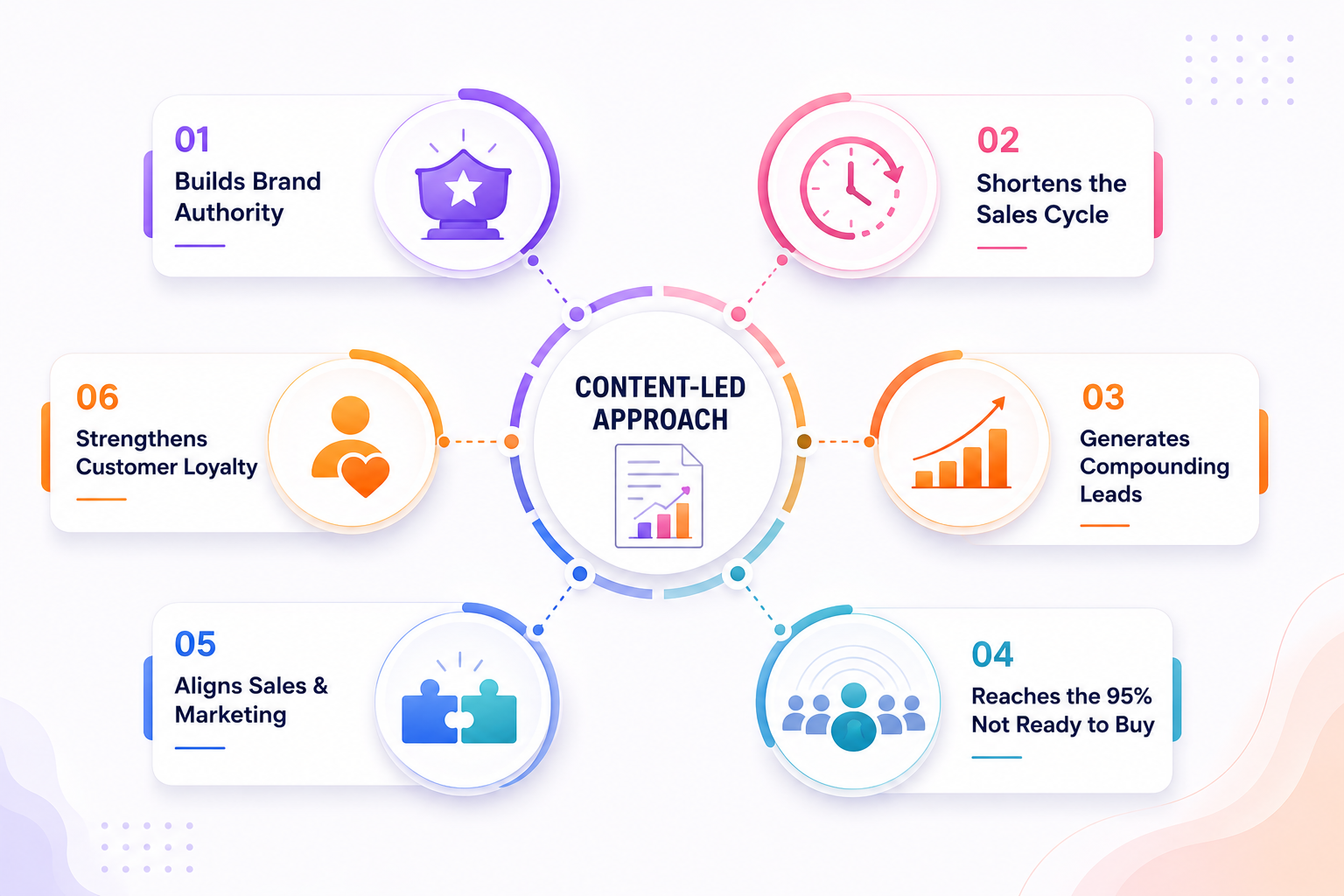
1. It Builds the Authority That Differentiates You in Crowded Markets
In most B2B categories, multiple vendors offer technically comparable solutions. Features can be copied. Pricing can be matched. But genuine intellectual authority, the reputation for producing the sharpest thinking in your space, is very hard to replicate quickly.
A company that consistently publishes original research, well-argued perspectives, and expert analysis earns a different status in the buyer’s mind. It becomes the reference point, the brand decision-makers cite when explaining a trend, or recommend to a colleague looking for a trusted provider.
According to a report, 93% of B2B marketers using original research-based content report it as effective at driving engagement and leads, with nearly half calling it very effective.
That kind of authority creates a gravitational pull. The marketing budget cannot buy it. It has to be earned, piece by piece, through consistently valuable content.
2. It Shortens the B2B Sales Cycle Through Better Buyer Education
The B2B buying committee typically involves five to ten stakeholders, each with different priorities. A CIO cares about security and integration. A CFO wants ROI clarity. An end user wants ease of adoption. Addressing each of these concerns through targeted content means that by the time a prospect enters a sales conversation, most of their objections have already been answered.
A content-led approach addresses these concerns early through:
- Case studies
- Comparison guides
- Whitepapers
- ROI calculators
- Implementation resources
Mapping content deliberately to the buyer journey makes this work, awareness-stage content that surfaces the problem, consideration-stage case studies and comparison guides that establish credibility, and decision-stage tools like ROI calculators and implementation playbooks that remove final hesitations.
3. It Generates Leads That Compound Over Time
This is one of the most powerful economic arguments for a content-led approach. Paid advertising stops the moment the budget stops. A well-optimized article published today can attract and convert leads for the next three to five years.
The cost-per-lead from content decreases over time as the asset base grows and organic rankings strengthen. The early investment in producing high-quality content builds a portfolio that delivers compounding returns, more traffic, more leads, and more pipeline without proportional increases in spend.
For B2B marketing leaders under pressure to demonstrate efficiency and ROI, this is a compelling structural advantage. Content-led growth is not just sustainable; at scale, it is structurally cheaper than paid-only demand generation strategies.
Related Guide → How Content Marketing Drives B2B Lead Generation
4. It Reaches the 95% of Buyers Who Are Not Ready to Purchase Yet
Here is a reality that most B2B marketing strategies ignore: at any given moment, 95% of your potential market is not actively looking to buy. They are not comparing vendors. They are not filling out RFP forms. But they are reading industry content, staying informed, forming opinions about which companies seem authoritative and which do not.
A content-led strategy reaches this dormant majority. By publishing genuinely useful, non-promotional content, the kind that helps someone do their job better regardless of whether they ever buy from you, you build familiarity and credibility with buyers long before they are ready to act.
A content-led strategy keeps brands visible during this phase through:
- Educational blogs
- Thought leadership
- Industry analysis
- Research-backed insights
- Problem-solving content
5. It Aligns Sales and Marketing Around a Shared Asset Base
The sales-marketing misalignment problem is real and costly in most B2B organizations. Marketing generates content that sales never uses. Sales has conversations that never inform content strategy. Both teams work harder than necessary as a result.
A content-led approach forces productive alignment. When content is positioned as a core commercial asset rather than a marketing deliverable, sales teams have a genuine reason to use it because it actually helps them sell.
High-performing content assets include:
- Industry-specific case studies
- Objection-handling whitepapers
- Customer success stories
- Data reports
- Buyer education guides
The feedback loop this creates is equally valuable. Sales teams hear the real questions, concerns, and decision triggers that prospects articulate in live conversations. That intelligence feeds back into content strategy, producing material that is progressively more useful and conversion-focused over time.
6. It Strengthens Customer Retention and Long-Term Client Loyalty
The relationship between a B2B company and its clients does not end at the contract signature.
Ongoing content, onboarding guides, best practice newsletters, product update explainers, and sector trend reports deepen the value of the partnership and keep clients engaged between formal touchpoints.
A report states: 70% of C-suite executives indicated that thought leadership content had caused them to reconsider their existing vendor relationships. The implication cuts both ways. If your content is excellent, it deepens client loyalty. If your competitor’s content is better than yours, it creates a genuine retention risk. Content quality is not just an acquisition lever it is an active factor in whether your existing clients stay.
What Does It Actually Take to Build a Content-Led B2B Strategy?
Knowing the strategy works is not the same as knowing how to build one. Most content programs underdeliver not because the idea is wrong but because execution is inconsistent, underfocused, or unmeasured.
Start with audience depth, not content volume
The instinct is to publish more. The right instinct is to publish more precisely. The most effective content comes from teams with a granular understanding of their target audience, not just job titles and industries, but the specific professional challenges, knowledge gaps, and decision triggers that drive their behavior. Customer interviews, sales team debriefs, and keyword research that maps search intent are all essential inputs.
Build a structured content calendar tied directly to business goals
Random publishing does not build authority. A deliberate editorial calendar with clear themes, formats, cadences, and distribution plans ensures that content works as a coherent system rather than a collection of disconnected pieces. Every piece should serve a purpose: generating awareness, addressing a specific objection, supporting a segment of the funnel, or reinforcing a key differentiator.
Treat distribution as seriously as creation
Brilliant content that nobody reads delivers no business value. SEO optimization, email distribution, LinkedIn amplification, executive thought leadership profiles, and strategic industry partnerships are all essential parts of a content-led system. Creation and distribution should receive roughly equal strategic attention and resource investment.
Measure what connects to revenue.
Page views and social shares are vanity metrics. The measurements that matter are pipeline influenced by content, organic lead volume, deal velocity for content-nurtured versus non-nurtured prospects, and conversion rates at different funnel stages. Embedding these measurements from the start allows the strategy to improve continuously and to make an undeniable case for continued investment.
How Do You Measure Whether Your Content-Led Strategy Is Working?
Content-led marketing is not a leap of faith. Every piece generates trackable signals, and connecting those signals to commercial outcomes is what separates serious programs from content for content’s sake.
Key metrics at each funnel stage:
- Awareness: Organic traffic growth, social reach, content shares, and branded search volume.
- Engagement: Time on page, scroll depth, return visits, email open and click rates.
- Lead generation: Content downloads, webinar registrations, form completions, lead quality scores.
- Pipeline impact: Content-assisted opportunities, deals where a prospect engaged with content before converting.
- Revenue: Revenue influenced by content, cost per content-sourced lead versus other channels.
Modern CRM and marketing automation platforms make this attribution straightforward. The brands that treat content performance as a continuous optimization loop, doubling down on what drives pipeline and cutting what does not, consistently improve their ROI over time and build the business case for sustained investment.
Final Thoughts
At its core, understanding how a content-led approach improves B2B marketing comes down to this: modern B2B buyers are not waiting to be sold to. They are conducting their own research, forming their own opinions, and making shortlists before your sales team knows they exist.
Content meets those buyers where they are. It earns their attention by being genuinely useful. It builds the trust that high-value B2B relationships require. It compresses sales cycles, lowers acquisition costs, retains clients, and creates competitive advantages that deepen with time.
For B2B organizations serious about durable, scalable growth, a content-led approach is not an optional enhancement to the marketing mix. It is the foundation on which everything else should be built.
Building a content-led strategy takes more than publishing consistently. It requires a deep understanding of your audience, a clear content strategy, and a commitment to creating content that supports measurable business growth. If you’re ready to build a content-led marketing strategy that strengthens your brand, engages decision-makers, and drives long-term commercial results, Get in Touch with the Tangence team to start the conversation.
Read Next → How B2B Content Marketing Generates High-Quality Leads
FAQs:
Q1. How is a content-led approach different from traditional B2B content marketing?
Traditional content marketing supports other tactics. A content-led approach makes content the strategic foundation for every channel, from paid media to sales outreach, that exists to amplify it. One is an activity; the other is the entire operating model.
Q2. How long before a content-led B2B strategy delivers measurable results?
Most companies see organic traffic growth within three to six months. Measurable lead impact typically follows at six to twelve months. The compounding returns content generating leads for years become significant between months twelve and thirty-six.
Q3. What content formats work best in B2B marketing?
Original research, detailed case studies, in-depth guides, expert webinars, and data-driven analysis consistently outperform. Format matters less than whether the content helps buyers make smarter decisions; quality is what builds lasting authority.
Q4. How do you measure the ROI of a content-led strategy?
Track pipeline influenced by content, organic lead volume, deal velocity for content-nurtured prospects, and funnel conversion rates. Authority signals, such as search rankings, inbound links, and press mentions, indicate the trust-building progress that converts into revenue over time.
Q5. Can smaller B2B companies compete with larger ones through content?
Yes, content is the great equalizer. A sharp, well-researched article from a small firm regularly outranks a generic post from a global enterprise. Authority is earned through quality of thinking, not the size of the budget.