blog
Top B2B Content Marketing Trends Shaping Growth in 2026
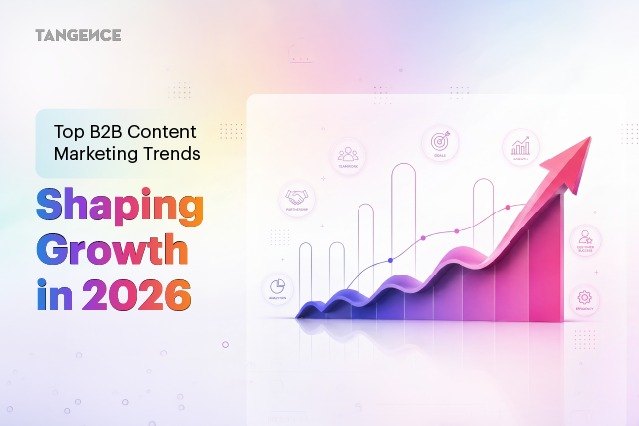
B2B content marketing in 2026 is no longer a volume game. It is a trust economy driven by expertise, relevance, and buyer experience. Modern buyers spend weeks researching solutions before they ever book a call. They compare brands across multiple channels, study customer feedback, and expect every piece of content to deliver real strategic value.
Generic blog posts and sales-heavy messaging no longer earn attention. Precision does. The brands leading today are building authority with data-backed insights, audience-specific storytelling, and high-intent content ecosystems that guide buyers through every stage of the decision journey.
This shift has completely redefined what effective B2B content marketing looks like. In this article, we break down the most important B2B content marketing trends shaping growth, visibility, and revenue in 2026.
7 B2B Content Marketing Trends to Watch in 2026
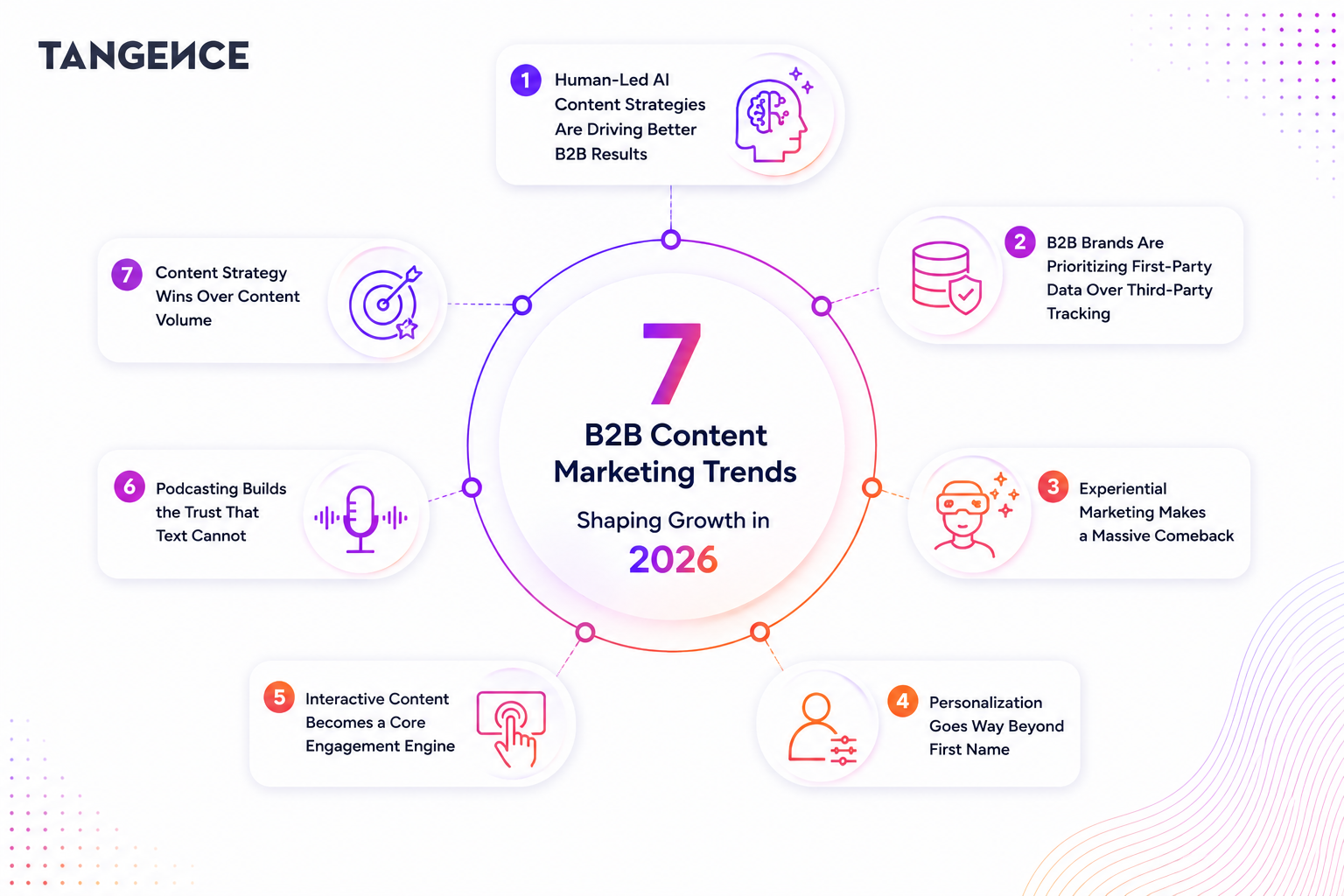
Trend 1: Human-Led AI Content Strategies Are Driving Better B2B Results
Let’s start with the big one. AI is everywhere in 2026. According to a survey, nearly 95% of organizations now use AI-powered marketing applications. That number is hard to ignore.
But here is what surprises most people. The biggest wins from AI are not coming from creative breakthroughs. They are coming from speed and efficiency. Marketers report that AI helps them produce content faster and run operations more smoothly. The deeper metrics, like content quality and performance improvement are still catching up. This shift is reshaping modern B2B strategies, making AI-powered automation one of the biggest b2b content marketing trends brands cannot afford to ignore in 2026.
AI Makes You Faster. Strategy Makes You Better.
So what does this mean for your team? It means AI is a tool, not a strategy. The marketers pulling ahead are those who treat AI as amplification for a solid plan. They are not using it to churn out more average content. They use it to deliver smarter content more consistently.
Here is what the leading B2B content teams use AI for today:
- Content creation: generating and refining written copy faster
- Creative asset production: editing images and short-form video at scale
- SEO optimization: identifying keyword gaps and content opportunities
- Predictive analytics: spotting buyer intent signals before the sales team does
- Email personalization: tailoring messages based on behavior data
The teams still stuck in “explore mode” are using AI to type faster. The teams winning are using it to think more sharply. That gap will only grow wider as 2026 moves forward.
This brings up an important question. If AI handles speed, then what do humans handle? The answer is strategy. And strategy lives in data. Which leads us to the next major shift happening right now.
Trend 2: B2B Brands Are Prioritizing First-Party Data Over Third-Party Tracking
First-party data is customer information collected directly through your own website, platforms, campaigns, and audience interactions, behavioral data, etc..
Third-party cookies are gone. Buyer privacy expectations are higher. And yet most B2B companies still do not have a clear first-party data strategy. Research shows that while 91% of B2B marketers collect first-party data, almost half admit their strategy remains in early stages.
This is a massive missed opportunity. First-party data gives you something no algorithm can buy: direct knowledge of your audience. What they click. What they download. What problems keep them up at night?
Here is how smart B2B teams collect and use first-party data:
- Gated content assets: whitepapers and research reports that capture intent
- CRM and sales conversation data: turning sales insights into content topics
- Website behavioral tracking: understanding which pages signal buying intent
- Email engagement patterns: identifying content themes that drive action
- Community and event participation: capturing data from real buyer interactions
The payoff is real. B2B marketers who use first-party data well report better targeting and stronger buyer relationships. More importantly, they report increased conversion rates. Data without governance, though, is just noise. Build the systems first. Then the strategy follows.
Explore Marketing Automation Solutions.
Trend 3: Experiential Marketing Makes a Massive Comeback
After years of digital-everything, B2B buyers are craving human connection again. Experiential marketing: events, demos, workshops, and immersive brand activations are surging back. Research shows that 78% of B2B marketers now allocate budget to experiential activities.
More telling is what happens to sales cycles when experiential touchpoints are added. Among those who track the data, over half say deals close faster when experiential marketing plays a role in the buyer journey.
Digital Events Are Not Enough Anymore
The smartest B2B content teams now blend digital and in-person experiences. They design moments that give buyers something to remember. Something to talk about. Something that builds real trust in ways a well-crafted blog post simply cannot.
Here is how B2B brands use experiential marketing effectively in 2026:
- Executive roundtables and VIP dinners: exclusive settings that accelerate relationship building
- Live product workshops: hands-on sessions that reduce buyer hesitation
- Hybrid events: combining in-person energy with digital reach
- Community gatherings: bringing buyers together around shared challenges
- Branded immersive demos: showing the product in action rather than describing it
Experiential marketing costs more. It takes more planning. It carries more risk. That is exactly why most companies avoid it. And that is exactly why the brands that do it right create a differentiation gap that competitors struggle to close.
Looking to create memorable brand experiences that strengthen buyer relationships?
Explore Tangence Event Services.
Trend 4: Personalization Goes Way Beyond First Name
Most B2B marketers say they personalize content. Most of them only mean they add a first name to an email subject line. Real personalization in 2026 looks completely different.
Research shows that 89% of B2B organizations personalize content in some way. But 59% describe their approach as basic. Only 6% reach extensive or comprehensive personalization across multiple touchpoints. That gap represents an enormous growth opportunity for the teams willing to invest in getting it right.
The Buyers Who Receive Real Personalization Actually Buy
Modern B2B buyers do most of their research before they ever speak to a sales rep. This means your content must speak to their specific situation at every stage of that invisible journey.
Here is what meaningful personalization looks like in B2B content marketing:
- Account-specific content: custom assets built around a target company’s unique pain points
- Buyer stage alignment: creating different content for the awareness, consideration, and decision stages of the buyer journey.
- Behavioral content triggers: serving content based on what a buyer actually did on your website
- Industry vertical messaging: speaking the language of specific sectors, not generic audiences
- Role-based content experiences: different messages for the CFO versus the IT director versus the end user
Buyers can smell shallow personalization instantly. Adding a company name to a generic email does not count. What counts is content that makes a buyer feel like you understand their world better than they do themselves.
With personalization working at scale, you create content experiences that convert. But to convert consistently, you need your content to actually get found.
Want to deliver personalized experiences at scale?
[See how email campaigns and landing pages support personalization → https://www.tangence.com/Emails-and-Landing.php
Trend 5: Interactive Content Becomes a Core Engagement Engine
Static content is losing the battle for attention. B2B buyers in 2026 want to participate, not just read.
Interactive content: quizzes, calculators, assessments, surveys, polls, and tools give them exactly that.
Research confirms this shift. 85% of B2B marketers have already adopted or plan to adopt interactive content formats in their strategy. The reason is not just engagement. It is data. Every interaction a buyer takes inside a piece of interactive content tells you something valuable about where they are in the buying journey.
Make Content Work Both Ways
Think about a pricing calculator on your website. A buyer who spends five minutes adjusting inputs is a very different signal than someone who downloads a PDF and disappears. Interactive content makes the invisible journey visible.
Here is how B2B teams use interactive content to drive both engagement and insight:
- ROI calculators: helping buyers justify investment in your solution
- Assessment tools: diagnosing a buyer’s current situation and recommending a path
- Interactive surveys: gathering audience data while delivering a useful experience
- Quizzes: educating buyers on their own gaps in an engaging format
- Comparison tools: making it easy for buyers to evaluate options clearly
The beauty of interactive content is that it works across the entire funnel. It attracts traffic at the top. It qualifies intent in the middle. It accelerates decisions at the bottom. And it generates first-party data at every single step.
Trend 6: Podcasting Builds the Trust That Text Cannot
B2B buyers listen to podcasts while driving, during workouts, on lunch breaks, and while commuting. Audio content reaches buyers in moments when no other content format can. That is why podcasting continues to grow as a legitimate B2B content marketing channel in 2026.
The real power of a B2B podcast is not reach. It is trust. When a buyer listens to your team share real insights for 30 minutes every week, they develop a relationship before they ever become a prospect. By the time they need your solution, they already know and trust your brand.
Here is what makes a B2B podcast work as a growth driver:
- Consistent publishing: weekly or bi-weekly episodes that build audience habits
- Industry expert guests: bringing in external voices that add credibility
- Practical, actionable content: episodes that solve real problems buyers face
- Cross-channel repurposing: turning each episode into blog posts, clips, and social content
- Clear niche positioning: owning a specific topic rather than trying to cover everything
Podcasting also supports thought leadership goals perfectly. The two trends work together. A strong podcast builds the kind of authority that LinkedIn alone cannot deliver.
Trend 7: Content Strategy Wins Over Content Volume
Here is a truth that many B2B marketing teams resist. More content does not mean more growth. Better content with a sharper strategy does.
Around 74% of B2B marketers who improved their content strategy effectiveness pointed to strategy refinement as the primary driver. No more budget. Not more content. Better thinking and tighter direction.
The B2B teams that struggle produce random acts of content. A blog here. A webinar there. A social post that no one planned. The teams that win operate like publishers. They have editorial calendars. They have clear audience personas. They map every piece of content to a specific business goal. They measure what works and double down.
Here is what a content strategy built for growth in 2026 looks like:
- Audience-first planning: building content around buyer questions, not internal priorities
- Content pillars: owning three to five core topics with depth rather than skimming dozens
- Distribution strategy: knowing exactly how every piece of content reaches its audience
- Measurement frameworks: tracking pipeline influence, not just pageviews
- Content repurposing systems: turning one asset into ten without sacrificing quality
Strategy without measurement is just guessing. And measurement without strategy is just vanity metrics. The two must work together. When they do, content becomes a genuine revenue driver, not just a marketing cost.
Conclusion: Growth Goes to the Teams Who Connect the Dots
The top b2b content marketing trends in 2026 are not isolated tactics. They connect to each other. AI accelerates your content production, but strategy determines its direction. First-party data powers personalization, but governance makes data trustworthy. Experiential marketing creates trust, but measurement makes it accountable.
The teams that win do not chase every shiny new trend. They pick the ones that connect to their specific growth goals. They build systems. They invest in people. They measure what matters. And they show up consistently for their buyers at every stage of the journey.
B2B buyers in 2026 are more informed, more selective, and more demanding than ever before. They deserve content that meets them where they are. The brands that deliver that content with clarity, consistency, and genuine value will own the market in the years ahead.
Turn Content Trends Into Growth Opportunities
Knowing what is changing in B2B content marketing is only the first step. The real challenge is turning these trends into a strategy that drives qualified pipeline, buyer engagement, and measurable business growth.
At Tangence, we help B2B brands build data-driven content strategies that connect audience insights, personalization, AI, and demand generation into a cohesive growth engine.
Contact us today to discuss your content marketing goals and discover opportunities to accelerate growth in 2026 and beyond.
FAQs:
Q. What are the most important b2b content marketing trends in 2026?
Ans. The biggest b2b content marketing trends include AI-assisted content, first-party data collection, interactive experiences, podcasting, personalization, and strategy-driven content built around buyer intent and trust.
Q. How are companies using AI more effectively in 2026?
Ans. Businesses are using AI to improve efficiency, personalization, and audience targeting instead of just producing more content. Current b2b content marketing trends show that strategy still matters more than automation alone.
Q. What type of content drives the highest engagement today?
Ans. Interactive tools, podcasts, webinars, and research-based content perform strongly because buyers want practical insights and better experiences instead of generic promotional messaging.
Q. Why does first-party data matter more than before?
Ans. First-party data helps brands understand customer behavior directly from their own platforms. Many b2b content marketing trends now rely on this data to improve personalization and conversion performance.
Q. How can businesses improve their content strategy in 2026?
Ans. Companies should focus on audience intent, consistent publishing, strong distribution, and measurable goals. The strongest b2b content marketing trends are built around relevance, quality, and long-term relationship building.