blog
How to Repurpose Podcast Content: 10+ Ideas & Examples
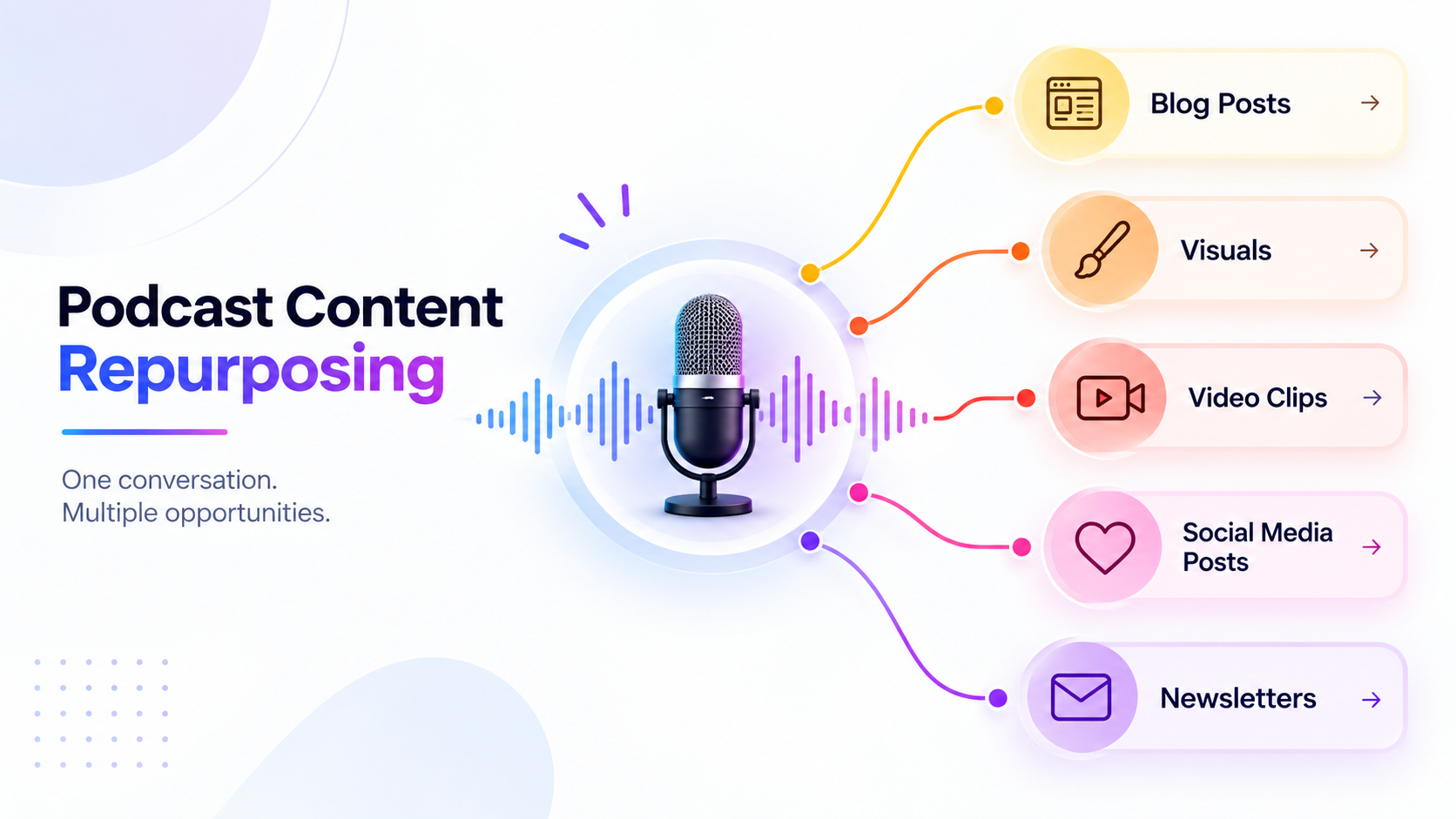
Podcast content can be repurposed into social media clips, blog posts, email campaigns, YouTube videos, newsletters, infographics, downloadable resources, webinars, and community discussions. The key is to treat every podcast episode as a source asset, not a finished piece of content.
More than 55% of Americans aged 12 and older listen to podcasts at least once a month, highlighting the format’s wide reach. A single 45-minute interview can contain dozens of useful ideas. You can extract insights for short-form videos, turn the main discussion into an SEO-friendly article, convert quotes into graphics, and use listener questions for follow-up content.
Podcast repurposing also makes content production more efficient. Instead of creating every social post, article, email, and video from scratch, you build multiple assets from one original conversation.
The goal is not to copy an episode into different formats. The goal is to adapt the original idea to the way people consume content on each channel.
What Is Podcast Content Repurposing?
Podcast content repurposing is the process of turning one original podcast episode into multiple pieces of content for different platforms and audiences.
For example, a single interview can become:
- A full YouTube video
- Several short-form videos
- A blog article
- A LinkedIn post
- An email newsletter
- Quote graphics
- An infographic
- A downloadable checklist
- A guest promotion kit
- A webinar
- Community discussion prompts
This creates more opportunities for people to discover the same idea.
However, effective repurposing does not mean publishing the same content everywhere. Each format should have its own purpose.
A 45-minute podcast may work well for someone who wants a detailed conversation. A 45-second video clip may work better for someone scrolling through social media. A blog article may work better for someone searching Google for a specific question.
The original episode remains the foundation. Each repurposed asset provides another entry point.

Why Should You Repurpose Podcast Content?
Podcast repurposing helps you extend the value of the work already invested in recording an episode.
Producing a quality podcast involves research, guest preparation, recording, editing, publishing, and promotion. Limiting that work to one audio or video file leaves many useful ideas unused.
Repurposing solves this problem by creating a content system around every episode.
Reach Different Audience Segments
Not everyone consumes content in the same format.
Some people prefer podcasts. Others discover ideas through LinkedIn posts, Instagram Reels, YouTube Shorts, newsletters, or search engines.
Repurposing allows the same core idea to reach these different audiences without requiring an entirely new recording for every channel.
Increase Content Output Without Starting From Scratch
Your podcast already contains original ideas, examples, opinions, questions, and stories. You can extract those elements instead of constantly brainstorming new topics.
This can make your content calendar easier to maintain.
Extend the Life of Older Episodes
An episode does not have to disappear from your marketing strategy after its launch week.
An older episode can be revisited when its topic becomes relevant again. You can create a new clip, update an article, publish a quote, or build a new discussion around one of its ideas.
10+ Best Ways to Repurpose Podcast Content
1. Turn Podcast Episodes Into Short-Form Videos
Short-form video is one of the most practical ways to repurpose podcast content.
A long episode usually contains several moments that can stand alone. These may include a strong opinion, surprising statistic, useful tip, personal story, disagreement, question, or concise explanation.
Do not simply cut random 30-second sections. Choose moments that contain a complete idea.
A better process:
- Isolate one idea per clip. If a segment touches three topics, that’s three clips, not one.
- Front-load the hook. Move the strongest line to the first three seconds, even if that means reordering what was said.
- Design for sound-off viewing. Captions and an on-screen headline should carry the point even if no one hears a word.
- End with a next step. Point viewers to the full episode, your profile, or the next clip in a series.
Clips that go somewhere that isolate a single sharp idea instead of trying to summarize the whole conversation consistently outperform generic 60-second excerpts with no hook and no editing logic.
2. Turn the Transcript Into a Search-Optimized Blog Article
A podcast transcript can provide the raw material for a valuable article, but a transcript should not automatically become the finished article.
Spoken conversations contain repetition, incomplete sentences, tangents, and informal language.
A strong article needs structure.
Start with the main question or topic discussed in the episode. Then organize the useful information into logical sections.
For example, a podcast episode titled:
“How Can B2B Companies Improve Lead Generation?”
could become an article titled:
“How Can B2B Companies Improve Lead Generation in 2026?”
The article can then organize the conversation around:
- Identifying the right audience
- Creating useful content
- Building demand
- Improving conversion paths
- Measuring lead quality
- Avoiding common mistakes
This approach transforms the conversation into an evergreen resource.
Do Not Publish the Raw Transcript
A raw transcript may be useful as an accessibility resource, but it usually needs editorial work before becoming a strong article.
Instead:
- Identify the central topic.
- Extract the strongest insights.
- Remove repetition.
- Group related ideas.
- Add useful headings.
- Rewrite conversational language.
- Add examples and context.
- Link back to the original episode.
- Add a relevant CTA.
The result should read like a professional article, not a conversation copied from a recording.
3. Publish Full Episodes as Long-Form YouTube Content
Video podcasts can become a genuine discovery engine on YouTube, but only if they’re packaged as a viewing product rather than an archived recording. Viewers decide whether to stay within the first few seconds, based on framing, pacing, and whether the title promises something specific.
To make this work:
- Title around the outcome, the question answered, or the problem solved, not the guest’s name alone.
- Keep a consistent thumbnail style so the channel reads as a series, not a scattered upload history.
- Cut long intros; open with the most compelling moment.
- Add chapters and timestamps so longer episodes feel navigable.
- Group related episodes into playlists by topic or audience type.
- Use end screens and pinned comments to route viewers to the next relevant video.
For example, a 60-minute interview about AI marketing could become a YouTube video with chapters such as:
00:00 Introduction
03:12 How AI is changing search
12:45 What marketers should automate
24:10 Where human expertise still matters
38:20 Common AI marketing mistakes
51:40 What marketers should do next
This makes the long-form content easier to navigate.
4. Build a Social Media Content Series
Instead of publishing one clip and moving on, turn one episode into a short social media series.
This works particularly well when the episode contains a process, story, framework, or debate.
For example, an episode about launching an ecommerce business could become:
Post 1: The biggest mistake new ecommerce brands make
Post 2: How to choose the right product
Post 3: What to validate before spending on ads
Post 4: How to calculate your first marketing budget
Post 5: What the guest would do differently today
The posts are connected but still useful individually.
You can also build a narrative sequence:
Part 1: The problem
Part 2: Why the problem happens
Part 3: The solution
Part 4: How to apply the solution
This creates more continuity than publishing unrelated clips.
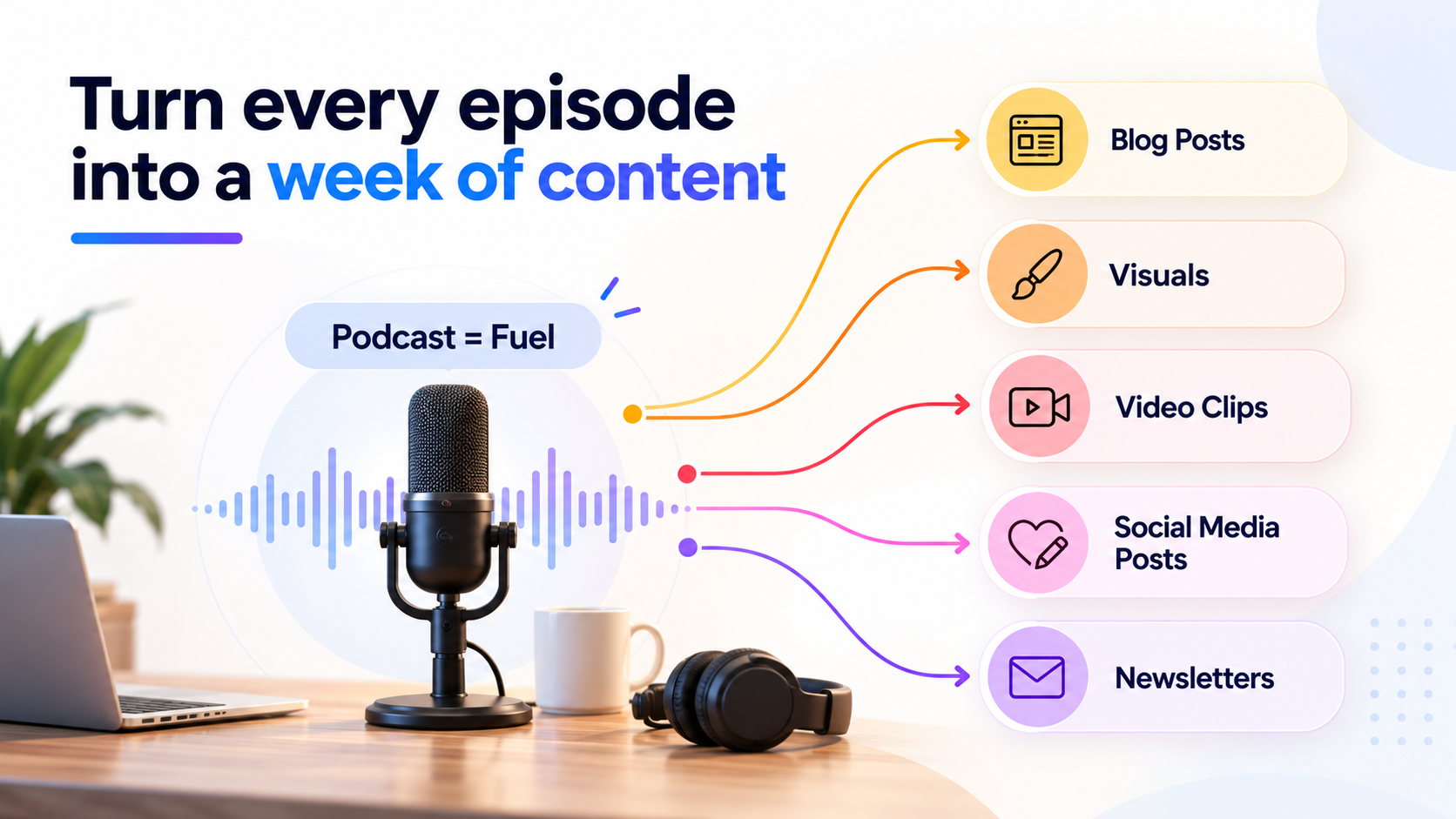
5. Turn One Episode Into an Email Newsletter Series
Email is another effective way to extend a podcast episode.
Instead of sending one email that says, “New episode available,” build a short content sequence around the episode.
For example:
Email 1: Introduce the Topic
Explain the problem and introduce the episode.
Email 2: Share the Biggest Insight
Take one useful lesson from the conversation and explain it in the email.
Email 3: Share a Practical Framework
Turn the guest’s framework into a short checklist or process.
Email 4: Share a Quote or Story
Use a memorable moment from the episode to reinforce the main point.
Email 5: Drive Readers to the Full Episode
Invite subscribers who want more detail to listen to the complete conversation.
The important point is that each email should provide value on its own.
Do not turn the sequence into five versions of the same promotional message.
Reference material also recommends creating multiple emails from a single podcast episode, including announcements, recaps, downloads, and supporting content.
6. Create Quote Graphics and Social Cards
Podcasts are full of statements that can become visual content.
When reviewing the transcript, identify short statements that communicate a complete idea.
For example:
“Your audience does not need more content. It needs more useful content.”
That statement could become a branded LinkedIn graphic, Instagram post, or newsletter visual.
Good quote graphics should be:
- Short
- Easy to understand
- Relevant to the audience
- Visually consistent
- Attributed to the speaker
- Connected to the original episode
Avoid turning every sentence into a graphic. Choose statements that can stand on their own.
7. Turn Podcast Insights Into Infographics
Infographics work especially well when a podcast includes a framework, process, comparison, or set of statistics.
Suppose a guest explains a five-step customer retention process.
Instead of leaving that framework inside a 50-minute conversation, turn it into:
5 Steps to Improve Customer Retention:
- Identify churn patterns.
- Segment customers.
- Find friction points.
- Improve onboarding.
- Measure retention over time.
The infographic gives people a quick way to understand the idea.
It can then link back to the full episode for additional context.
Reference material similarly identifies frameworks, comparisons, data points, and strong quotes as useful source material for visual assets.
8. Create Downloadable Resources
A strong episode can become a lead magnet. This works particularly well when the conversation provides practical information that can be turned into a checklist, worksheet, template, or guide.
For example, an episode about SEO could become:
SEO Podcast Episode → SEO Audit Checklist
An episode about hiring could become:
Hiring Podcast Episode → Interview Scorecard
An episode about content marketing could become:
Content Marketing Episode → 30-Day Content Planning Template
The downloadable resource gives the audience something they can use immediately. It can also create a natural conversion path from content consumption to lead generation.
Possible downloadable formats include:
- Checklists
- Templates
- Worksheets
- Frameworks
- Resource guides
- Cheat sheets
- Playbooks
- Research summaries
Reference material also highlights exclusive downloadable content as a way to extend podcast material and support audience growth.
9. Turn Guest Interviews Into a Cross-Promotion Campaign
Your guest can become an important distribution partner.
But do not simply send the guest a link and ask them to share it.
Create a ready-to-use guest promotion package.
Include:
- Two or three short video clips
- A quote graphic
- A LinkedIn-ready post
- An Instagram caption
- A short email blurb
- The full episode link
- Suggested publishing dates
For example, if you interview a SaaS founder, provide the founder with a clip focused on their expertise.
Make the promotion useful for them too.
You can also create a dedicated landing page containing the episode, key takeaways, guest information, and related resources.
The goal is to make sharing easy.
A guest with a ready-to-publish asset is much more likely to promote the conversation than a guest who has to download the episode, find their favorite moment, create a post, and write their own copy.
10. Turn Podcast Content Into a Webinar or Mini-Course
Some podcast episodes contain enough educational material to become a structured learning experience.
Look for episodes that explain:
- A repeatable process
- A framework
- A methodology
- A specific problem
- A step-by-step strategy
Then expand the episode into a webinar or mini-course.
For example:
Podcast:
“How Can Businesses Build an Effective Content Strategy?”
Webinar:
“Build Your 90-Day Content Strategy in One Session”
The podcast provides the raw expertise.
The webinar adds:
- Slides
- Examples
- Exercises
- Templates
- Audience questions
- A clear outcome
- A CTA
For a mini-course, break the subject into short lessons.
One episode might become:
Lesson 1: Define the audience
Lesson 2: Identify content gaps
Lesson 3: Build topic clusters
Lesson 4: Create the content calendar
Lesson 5: Measure performance
This creates a more valuable asset than simply uploading the podcast recording into a course platform.
11. Turn Podcast Content Into a Community Discussion
Podcast content can also become the starting point for conversations inside a community.
Do not simply post:
“Here is our latest episode.”
Instead, extract one idea and ask members to respond.
For example:
“The guest says companies should stop measuring content success by traffic alone. Do you agree? What metric do you use?”
Or turn a framework into a challenge.
If the episode explains a five-step productivity system, ask members to apply step one during the week and report their results. This creates interaction around the content rather than simply distributing a link.
Community content can also generate ideas for future episodes. Questions, objections, disagreements, and member experiences can become the foundation for follow-up discussions.
How Do You Repurpose One Podcast Episode Into Multiple Assets?
The most efficient approach is to create a repeatable workflow. Do not wait until the episode is published to decide what to do with it.
Step 1: Record the Episode
Start with a strong conversation.
Ask questions that produce useful answers, examples, stories, frameworks, and opinions.
Step 2: Create a Transcript
Use an accurate transcription workflow to turn the recording into searchable text.
This makes it easier to identify valuable moments.
Step 3: Identify the Core Topic
Ask:
What is the most valuable problem this episode solves?
That becomes the central content theme.
Step 4: Extract Supporting Ideas
Look for:
- Five to ten strong quotes
- Three to five short-form clips
- One primary article angle
- One email angle
- One visual concept
- One downloadable resource
- One discussion question
What Is a Good Podcast Repurposing Strategy for 2026?
A strong strategy starts before you record. Choose topics that can generate multiple content formats. During recording, ask questions that produce complete explanations and memorable statements.
After recording, create the transcript.
Then identify the central theme and build your content assets around it.
A practical weekly system could look like this:
- Monday: Publish the full episode
- Tuesday: Publish a short-form video
- Wednesday: Publish a LinkedIn insight
- Thursday: Send an email based on one key lesson
- Friday: Publish a quote or carousel
- Following week: Publish the detailed blog article
- Following week: Release another clip
- Later: Turn the strongest framework into a downloadable resource
The exact schedule can change based on your audience and channels.
The important part is consistency.
Conclusion
Podcast repurposing is not about turning one recording into endless formats. It is about extracting more value from a strong original idea.
One podcast can become videos, articles, newsletters, infographics, webinars, social posts, and more. The key is to match each piece to the audience and purpose of the channel.
Start planning for repurposing before you record. Focus on topics that offer practical insights, frameworks, examples, and strong takeaways.
You already have valuable expertise, stories, and ideas in every podcast conversation. Contact Tangence to turn that content into SEO-friendly articles, social content, videos, newsletters, and other content assets that continue delivering value long after the episode is published.
Frequently Asked Questions
1. What is podcast content repurposing?
Podcast content repurposing is the process of turning one podcast episode into multiple content formats, such as blog posts, social media clips, newsletters, infographics, videos, and downloadable resources.
2. Why should you repurpose podcast content?
Repurposing helps you reach people on different platforms, increase content output, and get more value from the research and effort already invested in creating a podcast episode.
3. What can you turn a podcast episode into?
A single episode can become short-form videos, a blog article, LinkedIn posts, email newsletters, quote graphics, infographics, checklists, webinars, mini-courses, and community discussions.
4. Should you publish a podcast transcript as a blog post?
No. A raw transcript usually needs editing before publication. Remove repetition, organize related ideas, add headings, rewrite conversational language, and add useful examples and context.
5. How do you repurpose one podcast episode into multiple pieces of content?
Start with an accurate transcript, identify the main topic, and extract strong quotes, video clips, article ideas, email topics, visual concepts, downloadable resources, and discussion questions.
6. What is the best podcast repurposing strategy?
Plan for repurposing before recording. Choose topics that can produce multiple content formats, create a transcript after recording, and adapt each asset to the platform and audience rather than copying the same content everywhere.