blog
What Is Go-to-Market (GTM) Strategy? A Complete Guide for 2026 and Beyond
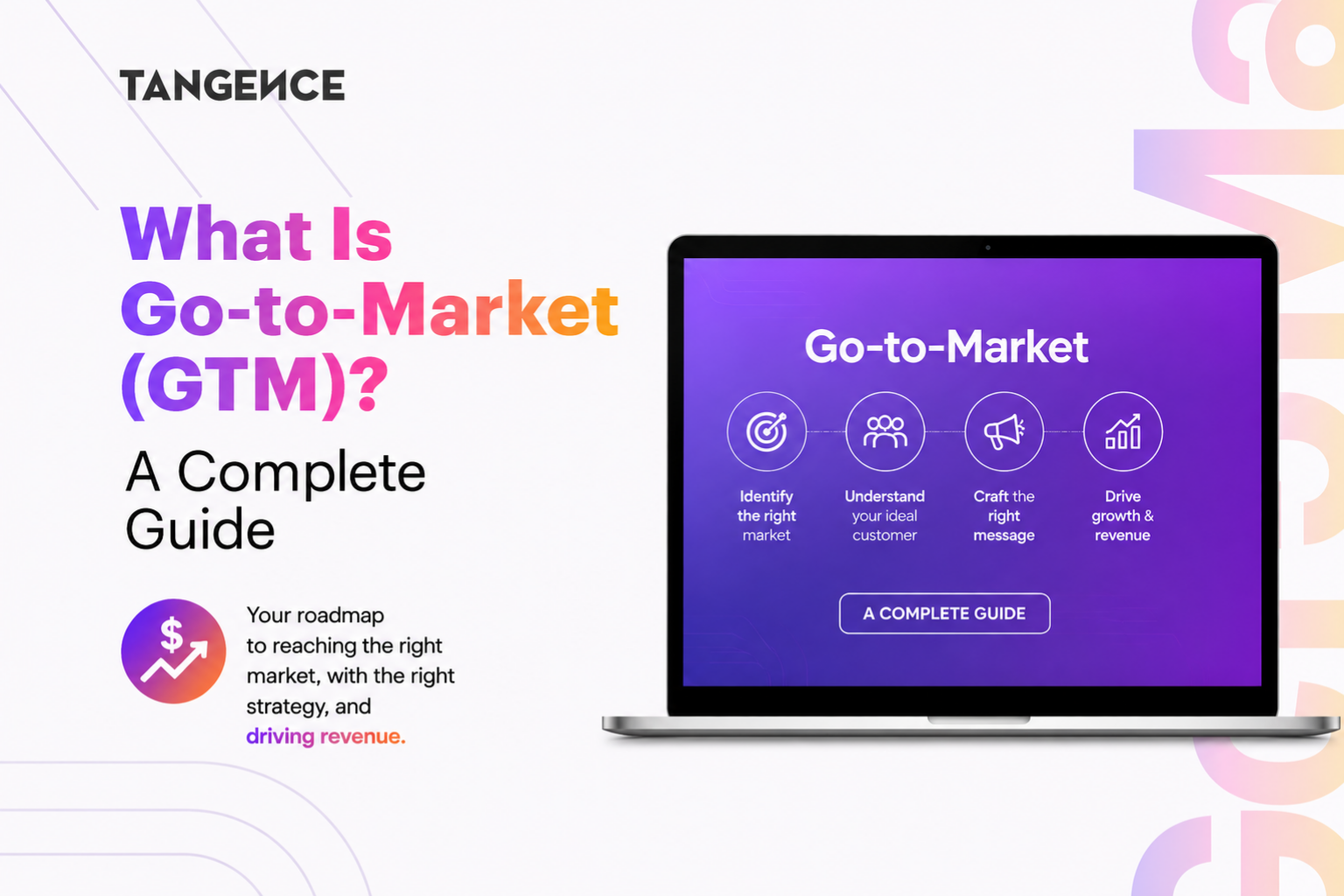
A go-to-market (GTM) strategy is a clear plan for taking a product to the right market and turning potential buyers into customers. It brings together the key decisions behind a launch: who you want to reach, why they should choose your product, how you will reach them, and how you will deliver value from the start. The goal is not simply to launch a product, but to create a focused path to market adoption without wasting time, money, or resources.
Most product launches don’t fail because of a weak product. They fail because nobody connects the dots between who buys the product and why they buy it. Research found that lack of real market need drives roughly 42% of startup failures. That single number explains why go-to-market planning matters right now. A go-to-market strategy is not a slide deck you build once and forget. It is a living plan that tells your team who to sell to and how to win them.
What Is a Go-to-Market Strategy?
A go-to-market strategy is the plan for how a product reaches the right market, attracts customers, and turns interest into sales. It brings together five core decisions: which market to target, who the customers are, how the product will reach them, how it should be positioned, and what it should cost.
A strong GTM strategy also keeps marketing, sales, product, pricing, and customer success aligned. These teams need to work from the same understanding of the customer and the market. Otherwise, the launch can lose direction quickly.
The Five Essential Elements of a Go-to-Market Strategy
- Market definition: Identify the market you want to enter and assess its size, growth, trends, and opportunities.
- Target customers: Define who you are selling to, including their needs, characteristics, challenges, and buying behaviour.
- Distribution model: Decide how the product or service will reach customers, whether through direct sales, partners, marketplaces, online channels, or a combination.
- Product messaging and positioning: Explain what the product offers, what problem it solves, and why customers should choose it over competing options.
- Pricing: Set a price that fits the target customer, market conditions, competitive landscape, and the value the product provides.
Together, these elements give a GTM strategy its direction. Market and customer decisions determine who you are trying to win; positioning explains why they should care; distribution determines how you reach them; and pricing determines how the offer is packaged and monetized.
Why Is a Go-to-Market Strategy Important
A go-to-market strategy helps a business enter a market with a clear plan instead of relying on assumptions. It shows what needs to be tested, where resources should go, and how the team will measure whether the launch is working.
Here is what a strong GTM plan delivers for your business:
- Reduces launch risk: Tests the market, customer demand, positioning, and pricing before major resources are committed.
- Clarifies the target customer: Helps teams focus on the people most likely to need and buy the product.
- Creates a clear value proposition: Makes it easier to communicate why the product is worth choosing over alternatives.
- Aligns teams: Gives product, marketing, sales, and customer success a shared direction.
- Improves resource allocation: Helps decide where to invest time, budget, people, and sales effort.
- Supports better pricing decisions: Connects pricing with customer value, competition, and willingness to pay.
- Makes distribution more effective: Identifies the channels where target customers are most likely to discover and purchase the product.
- Provides measurable goals: Establishes KPIs for leads, conversions, revenue, customer acquisition, retention, and other launch outcomes.
- Helps teams adapt faster: Creates a framework for learning from early results and changing the strategy when something is not working.
Note: The 4 Ps give your GTM strategy a simple framework: what you sell (Product), where you sell it (Place), what you charge (Price), and how you reach customers (Promotion). Balancing all four helps you build a more competitive market approach.
Go-to-Market Strategy vs Marketing Strategy vs Business Plan
These three terms get mixed up constantly. Each one answers a different question and each one has a different owner.
| Aspect | GTM Strategy | Marketing Strategy | Business Plan |
| Focus | Launching one product into one market | Building brand demand over time | The entire company direction |
| Scope | Narrow and specific | Broad across all products | Broadest of the three |
| Timeline | Tied to a launch window | Ongoing and revisited often | Multi year |
| Owner | Cross functional team | Marketing team | Leadership team |
| Goal | Successful adoption and revenue | Sustained demand and awareness | Long term company growth |
A go-to-market strategy usually lives inside a marketing strategy.
You run several GTM strategies over the life of one longer marketing strategy. Think of it this way. If the question is “what should this company become” that is a business strategy. If the question is “how does this product win this market starting now” that is a go-to-market strategy.
What Are the Different Types of Go-to-Market Strategies?
There is no single GTM approach that works for every business. The right strategy depends on factors such as the product, customer type, price, buying process, and how much support customers need before making a purchase.
Here are the main go-to-market approaches businesses use:
1. Product-Led GTM Strategy
A product-led strategy puts the product at the center of customer acquisition and growth. Instead of relying on a salesperson from the beginning, customers can sign up, explore the product, and understand its value on their own.
This approach is a strong fit for software products that are easy to try and require little setup.
Key features include:
- Free trials or free plans
- Simple self-service signup
- Guided onboarding
- In-product recommendations
- Usage-based upgrades
- Product-focused customer education
2. Sales-Led GTM Strategy
A sales-led strategy uses a dedicated sales team to move prospects from initial interest to purchase. It is particularly useful when the product is expensive, complex, or requires customization.
Sales representatives may conduct demonstrations, answer technical questions, negotiate pricing, and coordinate with different decision-makers.
Key features include:
- Product demonstrations
- Outbound prospecting
- Sales representatives and account executives
- Negotiation and contract discussions
- Personalized implementation
- Longer buying cycles
This model is widely used for enterprise software, cybersecurity, infrastructure, and other high-value B2B solutions.
3. Marketing-Led GTM Strategy
A marketing-led strategy uses content and promotional activities to attract potential customers before they interact with a sales team. The goal is to build awareness, generate demand, educate buyers, and create qualified leads.
It works particularly well when customers spend time researching different solutions before deciding what to buy.
Popular channels include:
- Search engine optimization
- Blog and educational content
- Paid advertising
- Email campaigns
- Webinars
- Social media
- Industry research and reports
Marketing-led growth can also support sales-led and product-led strategies by bringing more potential customers into the funnel.
4. Partner-Led GTM Strategy
A partner-led strategy allows a business to reach customers through other companies or organizations. Instead of building every sales and distribution channel internally, a company works with partners that already have access to its target market.
Partners can help with selling, implementation, referrals, integrations, or market expansion.
Common partner channels include:
- Resellers
- Agencies
- Referral partners
- Technology integrations
- Affiliate programs
- Cloud marketplaces
- Co-marketing arrangements
This approach can be especially useful when entering a new market or reaching customers through an established industry network.
5. Community-Led GTM Strategy
A community-led strategy grows through users, customers, creators, developers, and advocates. Instead of depending entirely on paid promotion or direct sales, the company encourages people to share knowledge, recommend the product, create resources, and help other users.
The result can be a strong network where existing users contribute to attracting and educating new ones.
Common elements include:
- Online communities
- User forums
- Tutorials and guides
- Open-source projects
- Developer programs
- Community events
- User-generated content
- Peer recommendations
This approach is particularly effective for developer products, open-source software, creator tools, and products with highly engaged user groups.
How to Build a Go-to-Market Strategy: A Step-by-Step Guide
A real GTM strategy isn’t a single planning meeting or a launch-day checklist; it’s a connected process that ties customer research, positioning, pricing, channel selection, internal alignment, and post-launch measurement into one plan. Here’s how to build it, step by step.
1. Define your launch goal
Before anything else, decide what success actually looks like. Are you trying to win new customers, break into enterprise accounts, drive adoption of an existing product, improve retention, or enter a new market?
This goal shapes every decision that follows: positioning, pricing, messaging, channels, and the metrics you’ll use to judge the launch. It also gives cross-functional teams a shared reason to prioritize the same things.
2. Identify the customer problem
Good launches start with the customer’s problem, not the product’s feature list. Talk to real customers, dig into support tickets, review competitor feedback, and look at the market broadly. You’re trying to understand why people go looking for a solution in the first place, how they cope without one today, and which outcomes actually matter to them.
3. Define your audience: ICP and buying center
Start with your ideal customer profile: mpany size, industry, team structure, technical maturity, budget, and typical use cases. But for most B2B purchases, you’re not selling to one person; you’re selling to a group.
- Initiator: First to raise interest or kick off the search
- User: Will actually use the product day to day
- Influencer: Shapes opinion among the rest of the group
- Decision maker: Gives final purchase approval
- Buyer: Controls the budget
- Approver: Often a C-suite sign-off above the decision maker
- Gatekeeper: Can slow or block the deal
In smaller companies, one person may hold several of these roles. Map out who’s who for your target accounts, then dig into each person’s goals and pain points, this is what separates a generic pitch from messaging that actually lands with the room.
4. Research the market and competitors
Look at how competitors position themselves, which problems they lead with, what they charge, and where their customers still seem frustrated (reviews are a good source for this). The point isn’t to build a feature checklist; it’s to find the gaps: the problems competitors underserve and the language that isn’t already crowded.
5. Build your value proposition
Explain, clearly, why a customer should choose you and ideally, why now. Anchor it in outcomes, not features: less time spent, fewer errors, better visibility, easier collaboration. A sharp value proposition doesn’t just sit on a website; it strengthens sales calls, onboarding, and every campaign built on top of it.
6. Build personas and role-based messaging
Turn your buying-center research into concrete personas, then write messaging for each one. What convinces an economic buyer (cost, ROI, risk) is rarely what convinces the end user (day-to-day usability), and a gatekeeper needs something different again.
Do this for every role in the buying center rather than writing one message and hoping it stretches.
7. Test your messaging before you scale it
Before committing real budget, run your messaging in small batches and see what actually converts. Figure out where your audience spends time: LinkedIn tends to outperform Instagram for B2B buyers, for instance, though that’s not a universal rule. If a channel isn’t gaining traction after a fair trial, move the budget rather than persisting out of habit.
8. Choose your GTM motion
A GTM motion is the way a company moves potential customers from first discovering a product to becoming paying customers. It defines how customers are reached, convinced, and converted.
The right motion depends on the product and buying behavior. Simple SaaS products may use a product-led approach, while complex or expensive solutions often need sales-led support. Some businesses rely more on content, partners, or communities, while others combine several motions.
9. Map the buyer’s journey
With personas and messaging ready, lay out the journey from both sides, what the buyer goes through, and what your team needs to deliver at each point:
- Awareness: The buyer knows a little but isn’t close to deciding; strong top-of-funnel content (a blog post, video, or whitepaper) needs to grab attention quickly.
- Consideration: The buyer has defined the problem and is actively weighing options, often after downloading something like an ebook.
- Decision: The buyer is close to committing; a free trial or a well-timed sales conversation usually closes the gap.
Ownership typically shifts along the way: marketing generally owns awareness, and sales takes over as a lead nears the decision stage.
10. Select your channels
Pick channels based on how your customers actually discover and evaluate products, not how many channels you can technically run. High-intent inbound audiences respond well to SEO and content; enterprise buyers often need outbound, webinars, partnerships, or events. Two or three channels run well tends to outperform effort spread across many.
11. Set pricing and packaging
Pricing shapes how the product is perceived, how easily it converts, and how it expands over time. Structure tiers and packaging around the value customers actually get, and make sure the pricing model fits the GTM motion, simple self-serve pricing for product-led SaaS, custom or usage-based contracts for enterprise deals.
12. Build the launch plan and content bank
Turn the strategy into an actual execution plan: timelines, deliverables, campaign schedules, approvals, and milestones. This is also when you build out the content the plan depends on whether it lives with product marketing or the broader marketing team. For larger launches, a project management tool helps keep dependencies and ownership visible across everyone involved.
13. Set success metrics, then launch and iterate
Define what success looks like before launch day, ambitious but realistic targets and track them consistently once you’re live: adoption, engagement, conversion, retention, revenue, and qualitative feedback. A GTM strategy doesn’t end at launch. Use what you learn to refine positioning, onboarding, channels, and pricing, and feed it into the next launch.
Common Go-to-Market Strategy Mistakes to Avoid
Even great products stumble when the GTM plan has gaps. Watch for these common failure points.
- Targeting an audience that is too broad or vague
- Leading with product features instead of customer outcomes
- Picking a motion that doesn’t match your price point
- Ignoring retention and focusing only on new signups
- Letting the strategy live in six different files with no single owner
- Skipping post-launch metrics and never adjusting the plan
The most common failure is the last one on this list. When your ICP lives in a slide, your pricing lives in a spreadsheet, and your launch plan lives in a project tool, nobody can see the whole strategy at once. The pieces drift apart until they contradict each other in the real market.
Metrics That Prove Your GTM Strategy Is Working
Numbers tell you if your strategy needs a fix or a full rebuild. Track these metrics consistently after every launch.
| Metric | What It Tells You |
| Customer acquisition cost | How much you spend to win one customer |
| Conversion rate | How many prospects turn into paying customers |
| Time to value | How fast a new customer feels the product work |
| Retention rate | How many customers stay after their first purchase |
| Sales cycle length | How long it takes to close an average deal |
| Pipeline growth | How much new opportunity your channels create |
Conclusion
A go-to-market strategy is not a document you write once and file away. It is a working agreement between the people who build your product and the people who sell it. The best teams keep four questions in view at all times. Who do we sell to. Why should they switch. How do we reach them. What makes them stay. When these four answers work together your launch has a real shot. When they drift apart even a great product struggles to find its market. Start small. Get specific about your buyer. Match your motion to your price. Then track the results and keep adjusting as your market tells you what works.
Ready to move your GTM strategy forward? Tangence can help you turn your marketing goals into focused, practical action. Get in touch with Tangence today to discuss your next growth opportunity and find the right path forward.
Frequently Asked Questions
What is a go-to-market strategy in simple words?
A go-to-market strategy is a plan that shows how a product reaches customers and wins their business. It covers your target buyer your pricing your channels and your launch steps in one place.
Who owns the go-to-market strategy inside a company?
Product marketing usually owns the GTM strategy. But it stays a team effort. Product sales customer success and leadership all contribute input and share responsibility for launch results.
What is the difference between GTM strategy and marketing strategy?
A GTM strategy focuses on one product entering one market during a launch window. A marketing strategy runs longer term and covers demand generation across every product a company sells.
How long does it take to build a GTM strategy?
Timelines vary by company size and product complexity. Most teams spend two to six weeks on research positioning and planning before launch execution actually begins across every team.
What is the most common GTM strategy mistake?
Targeting too broad an audience ranks as the top mistake. Vague targeting creates weak messaging and wastes ad spend. A sharp ideal customer profile fixes this problem early.
Do small startups need a formal GTM strategy?
Yes but keep it lean early on. A short one page version works well before product market fit. Build the full detailed strategy once your customer answers stop changing weekly.