blog
Motion-Based Creatives: The Missing Piece in Your Paid Advertising Strategy
You run paid ads. You tweak your targeting. You test your copy. But somehow your cost-per-click stays high, and your scroll-stopping rate stays low. The problem is not your audience. The problem is not your budget. The problem is what your creativity looks like when it hits someone’s feed at 11 pm while they are half-asleep on a sofa. Static images no longer cut through. People’s thumbs move faster than your banner can load a message. Motion-based creatives are the answer most advertisers overlook. They grab attention before the brain can decide to scroll. They tell a story in three seconds. They drive action before a viewer even reads a headline. This article breaks down exactly why motion creatives belong at the centre of your paid strategy and how to use them to win.
Why Motion Creatives Outperform Static Ads Every Time
The human eye reacts to movement. Our brains evolved through thousands of years of evolution to become alert to all moving objects because humans needed to track shifting signals in their environment, something modern ads now use to instantly grab attention. Your ad feed is a modern savanna, and motion wins that attention race every single time.
The numbers back this up hard. Look at what the data says:
- 20%People are more likely to remember video ads than static ones
- 73% of consumers prefer to learn about a product through a short video
- 2x better brand recall from motion versus still image formats
These are not soft metrics. These are the numbers that determine whether your ad spend builds revenue or burns cash. Static creatives now live in the bottom tier of performance because they ask the viewer to do the work. Motion creatives do the work for them.
The First Three Seconds Are Everything
The average viewer on Meta platforms takes 1.7 seconds to decide between continuing to watch or scrolling away from the content. The TikTok platform offers users an even shorter time period for decision-making. Motion-based creatives front-load the hook. A well-made motion creative hits the viewer with movement in the very first frame. This is the moment that decides whether your ad budget earns a return or vanishes into the feed.
The current successful brands in paid media develop their motion advertising content according to one basic principle, which requires them to display results before anything else. Show the skin glowing before showing the product. Show the before-and-after before showing the brand name. Motion makes this possible in a way static images never can.
Types of Motion Creatives That Actually Work in Paid Ads
Not all motion is equal. A low-effort GIF and a high-converting video ad live in completely different worlds. The following motion creative formats produce reliable results across various platforms:
- Short video advertisements (6-15 seconds): These are predominant on Meta, TikTok, YouTube pre-roll, and Instagram reels. They provide a single message and a single call to action.
- Cinemagraphs: These are still photos with a looping motion. A cup of hot coffee. A blinking eye. They appear high-grade, and they pause the scroll without the need to sound.
- Animated product demonstrations: It consists of motion pictures of the product in action without the need to have a live shoot. They are particularly effective when it comes to SaaS and e-commerce.
- Kinetic typography ads: Text that moves in rhythm with a message. These work without a face or a product. They are built entirely from words and motion, and they perform well on Facebook and YouTube.
- UGC-style motion creatives: Raw-looking short videos that feel like organic content. These reduce ad resistance as they do not appear like ads.
- Carousel animations: Swipeable motions that contain motion transitions that move a viewer through a story, a step at a time.
Each format suits a different stage of your funnel. Top-of-funnel needs broad hook energy. Bottom-of-funnel needs proof and urgency. Match your motion format to the funnel stage, and your conversion rates will respond.
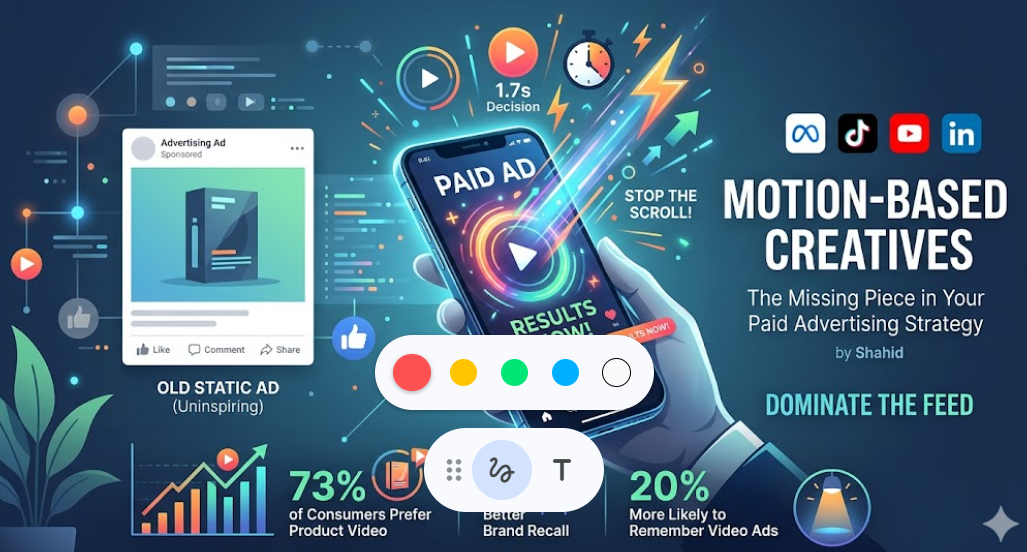
Image Source: Gemini
Platform Rules Change How You Build Motion
Instagram and TikTok reward vertical motion creatives built for sound-off viewing. YouTube rewards horizontal formats with strong audio storytelling. LinkedIn prefers to display content through soft movements, which include animated data displays and product demonstration videos. The quickest method to waste your creative budget involves creating a single video that you distribute to all platforms.
Build motion creatives natively for each platform. This means different aspect ratios. Different text placement. Different hook timing. The brands with the lowest cost-per-result on paid media are the ones that treat each platform as its own creative environment.
How to Build a Motion Creative Strategy That Converts
A motion creative strategy is not about making beautiful videos. It is about making videos that make your audience feel something fast and then act on that feeling. Here is the framework that works:
- Start with the pain point: Your first frame must show or imply the problem your product solves. Motion helps you dramatise that problem visually.
- Pattern interrupt: Surprising color shifts, rapid cuts, text that zooms in, this interrupts the autopilot scroll mode of the viewer.
- Always have captions on the screen: 85% of YouTube videos are viewed without sound. Movement without text loses the majority of the viewers.
- End with a single clear CTA: One action. One button. One instruction. Motion creatives that end with multiple options dilute conversion intent.
- Test motion versus non-motion on each campaign: A/B test in which motion versus non-motion is the only variable. Watch your click-through rate and cost-per-result tell you the truth.
- Refresh creatives every 3 to 4 weeks: Creative fatigue hits motion ads fast. The same video that crushed it in week one will underperform by week five.
Creative Testing Is Where Motion Creatives Pay Off Most
The biggest advantage motion creatives give you over static is the number of variables you can test. With a static image, you can test colour, layout, and copy. The motion creative test enables you to evaluate seven distinct elements, which include hook frame performance, pacing, music, caption style, CTA timing, and ending. The standard conversion price for your campaign can be decreased through each of these variables.
Brands that developed a consistent system to roll out new and fresh motion creatives are much more productive than those that treated it as merely a one-off event-definition task. Build a creative testing calendar. Set clear metrics for each test. Let data tell you which motion elements drive the most engagement and scale those elements into your next batch.
Common Mistakes That Kill Motion Creative Performance
Most advertisers get motion creative wrong in the same predictable ways. Knowing these mistakes saves you budget and months of poor results.
- Beginning too slowly: The quickest way to lose a viewer is to brand during the first frame prior to any hook. Be value-driven and present your brand once the viewer is already interested.
- Overloading the message: One motion creative. One message. One CTA. Attempts to describe five features within 15 seconds disorient the viewers and kill the conversion rates.
- Skipping the caption: Silent viewing is the default behavior on most platforms. Your motion creative must work without audio to reach most of your audience.
- Low-quality animation: Low-quality motion kills brand image quickly. A five-second animation will always be better than a clumsy half-second video.
- Not aligning creative to landing page: If your motion ad shows a red product and your landing page shows a blue one, you lose trust, and you lose the conversion.
The ROI Case for Investing in Motion Creatives Now
Motion creative production used to require a large team and a large budget. That is no longer true. Tools like Adobe Express, Canva Pro, CapCut for Business, and Runway ML let small teams produce high-quality motion creatives at a fraction of the old cost. The barrier to entry is gone.
What remains is a massive gap between advertisers who understand motion creatives and those who still default to static.
The ROI case writes itself. Motion creatives lower your cost-per-click. They raise your click-through rate. They improve brand recall. They drive higher conversion rates. Every dollar you invest in motion creative production comes back multiplied through paid media performance.
Conclusion
Your competitors are not standing still. The brands growing fastest in paid media right now treat motion creatives as a core business asset. They test them constantly. They refresh them regularly. They build them natively for every platform. They measure every frame against conversion data.
You do not need a film crew. You do not need a Hollywood budget. You need a clear hook. A focused message. A strong call to action. And motion that earns attention in the first two seconds before the thumb can scroll past.
Start with one motion creative this week. Test it against your best static ad. Watch what the data shows you. The results will make the decision for you. Motion-based creatives are not the future of paid advertising. They are the present, and the brands that act on this today are the ones that dominate their market tomorrow.
Your advertising strategy deserves the cutting-edge impact of high-performance motion graphics. Don’t let your brand get lost in the scroll. Partner with a dedicated motion design services agency like Tangence. We combine years of professional expertise with creative precision to build campaigns that demand attention. Elevate your paid media ROI today by entrusting your vision to the specialists at Tangence.