blog
B2B Landing Page Design: What High-Intent Buyers Need To See
A high-performing B2B landing page helps potential customers understand a solution, evaluate its business value, and take the next step. High-intent buyers need clear messaging, relevant product details, credible customer proof, and straightforward access to sales.
They are often comparing vendors, checking technical requirements, and preparing a business case before making a decision. Your landing page must answer these questions without unnecessary friction.
As per a report, the median landing page conversion rate was 6.6% across industries, compared with 3.8% for SaaS landing pages. These figures highlight why businesses should evaluate performance against relevant benchmarks.
Effective B2B landing page design turns buying interest into qualified leads through relevant information, trustworthy evidence, and a clear conversion path.
What Makes a B2B Landing Page Effective?
Clear messaging, relevant information, credible proof, and a straightforward conversion process make a B2B landing page effective. It focuses on the buyer’s business problem rather than describing the company at length.
The essential elements include:
- Clear headline: Communicate the primary benefit of your solution.
- Specific value proposition: Explain the problem you solve and the outcome buyers can expect.
- Customer proof: Use relevant case studies, testimonials, and verified results.
- Product details: Explain capabilities, use cases, integrations, and implementation requirements.
- Focused CTA: Encourage visitors to book a demo, request a quote, or contact sales.
- Simple form: Collect only the information needed for the next step.
- Commercial transparency: Address pricing, timelines, and support.
- Mobile-friendly design: Make the page easy to read and navigate on every device.
Each element supports the next. A strong headline captures attention, evidence builds confidence, and a clear call to action helps interested buyers move forward.
1. Match Landing Page Messaging to Buyer Intent
A high-intent buyer usually arrives with a specific question. They may want to understand pricing, compare product capabilities, evaluate integrations, or determine whether a solution fits their business requirements.
Your landing page should address that question instead of presenting generic company information.
Start by identifying the intent behind each important traffic source and page.
- Pricing pages: Explain packages, pricing factors, contract options, and available support.
- Product pages: Highlight relevant capabilities, workflows, and business outcomes.
- Comparison pages: Explain meaningful differences between solutions and provide evidence for your claims.
- ROI pages: Show the assumptions behind potential savings, efficiency gains, or financial returns.
- Demo pages: Explain what the demonstration covers and how visitors can arrange it.
For example, a company evaluating sales analytics software may care about reporting accuracy, CRM integrations, and the time required to prepare reports. A generic headline such as “Innovative Analytics Solutions” does not address those concerns.
A more relevant headline would be “Bring Sales and Marketing Performance Data Into One Reporting View.” Supporting content can then explain the integrations, reporting features, and business use cases.
2. Simplify Forms and Enable Instant Sales Conversations
A form can work well when visitors exchange their contact details for a guide, report, or other resource. However, a buyer who has already decided to speak with sales should not face unnecessary administrative steps.
Long forms, delayed responses, and back-and-forth scheduling can interrupt the buying process.
For a standard demo request, begin with essential information such as name, business email, and company name. Add fields such as job role, company size, or use case only when they improve qualification or meeting preparation.
Make the next step clear and convenient.
- Show available meeting times: Let visitors select a suitable slot without waiting for a scheduling email.
- Confirm bookings immediately: Explain when the meeting will happen and what the buyer should expect.
- Offer click-to-meet options: Let qualified visitors request an immediate conversation when sales coverage is available.
- Prepare representatives: Pass the prospect’s stated needs, relevant page activity, and qualification details to the assigned rep.
- Explain the handoff: Tell visitors who will contact them and what the conversation will cover.
For example, a visitor who clicks “Book a Demo” should see actual calendar availability or a clearly explained booking process. They should not receive a vague confirmation that someone may contact them later.
When Should You Use Scheduling Instead of Live Chat?
Use instant scheduling when the buyer wants a structured discussion, needs several stakeholders involved, or requires a specialist to prepare.
Live chat is useful when the visitor has a straightforward question and wants an immediate answer. An AI assistant can handle approved questions and direct qualified inquiries to the right person.
3. Use AI Chat for Qualification and After-Hours Coverage
B2B buyers do not always research solutions during business hours. They may visit your website at night, during regional holidays, or when their buying team is available to discuss options.
An AI chat assistant can provide initial support when sales representatives are unavailable. It can answer approved product questions, identify a visitor’s needs, collect relevant qualification details, and offer an appropriate next step.
Useful applications include:
- Answering common questions about products, services, and integrations.
- Asking about the visitor’s role, use case, or business requirements.
- Directing qualified prospects to the appropriate sales representative.
- Offering meetings through synchronized calendars.
- Summarizing buyer requirements before a sales conversation.
- Recommending relevant product documentation or technical resources.
The key is to keep qualification focused. Asking ten questions before answering a simple product question recreates the same friction that a long form creates.
4. Demonstrate Product Value With Interactive Walkthroughs and Customer Proof
B2B buyers need to understand how a solution works in their environment. Feature lists and broad marketing claims may attract attention, but practical demonstrations help buyers assess whether the product meets their needs.
Show the workflows that matter to the intended audience.
For example, a sales analytics platform could demonstrate how users connect CRM data, review pipeline performance, and generate reports. An enterprise infrastructure provider could explain compatibility, deployment requirements, and support arrangements.
Use co-browsing or browser-based screen sharing when direct visual guidance would help. These options can reduce setup friction when they allow visitors to follow a product walkthrough without installing another application.
A representative should focus on the buyer’s stated problem rather than delivering the same presentation to everyone.
Which Types of Customer Proof Should You Include?
Place evidence close to the claims it supports.
- Case studies: Explain the customer’s challenge, the solution, and the measured outcome.
- Testimonials: Include genuine feedback from relevant customers.
- Product demonstrations: Show how the solution works in realistic situations.
- Customer logos: Use recognizable brands only when you have permission.
- Technical documentation: Explain supported integrations, compatibility, and security controls.
- Third-party reviews: Link to credible independent assessments.
- Verified certifications: Display credentials your organization actually holds.
Suppose a case study reports that a customer reduced reporting time by 25%. Explain the customer’s context, measurement period, and how the result was calculated. Do not present that outcome as a guaranteed result for every prospect.
5. Prioritize High-Value Accounts With Relevant Personalization
Not every visitor represents the same commercial opportunity. A strategic enterprise account, a small business evaluating a self-service product, and a student researching a topic may arrive on the same page but require different follow-up.
Account-based marketing (ABM) helps sales and marketing teams prioritize accounts that match their target customer profile.
Start with practical segmentation criteria:
- Strategic accounts: Provide a named account owner and direct access to appropriate sales specialists.
- High-fit accounts: Offer relevant qualification questions and a clear meeting option.
- Standard accounts: Provide self-service resources, chat, and normal sales follow-up.
- Non-target traffic: Make educational content available without consuming unnecessary sales capacity.
Combine company information with actual engagement. Industry, company size, and strategic value can indicate fit, but they do not independently prove buying intent.
A target account visiting a careers page should not receive the same priority as one repeatedly reviewing product features, pricing, and integration documentation.
6. Automate Lead Routing and Behavioral Follow-Up
A landing page should do more than record a visit. It should help determine the appropriate next action when a visitor demonstrates meaningful interest.
Behavioral automation uses relevant actions to initiate qualification, scheduling, alerts, or follow-up. Common signals include pricing views, product comparisons, repeat visits, demo requests, and ROI-tool activity.
Create a small set of rules that marketing and sales teams can understand and maintain.
For example, a pricing-page visit from a recognized target account could notify the account owner. A completed qualification conversation from a high-fit prospect could offer an immediate meeting or route the inquiry to a specialist.
Each rule should answer five questions:
- Behavior: What action indicates potential buying intent?
- Context: Which company, role, campaign, or CRM details matter?
- Response: Should the system offer chat, scheduling, or specialist routing?
- Ownership: Who is responsible for the next step?
- Review: Does the rule produce qualified conversations and opportunities?
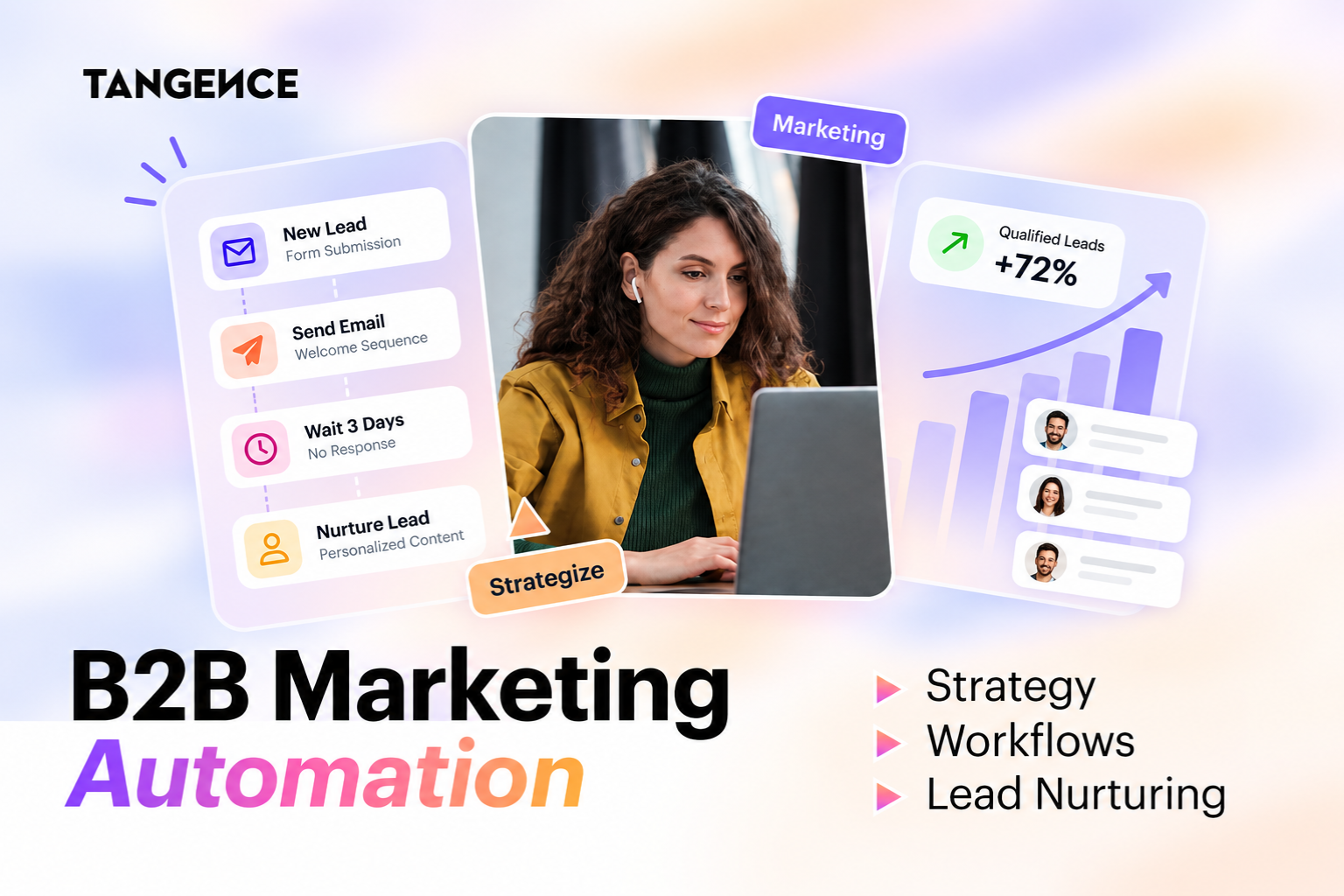
Read More: B2B Marketing Automation: Strategy, Workflows & Lead Nurturing
7. Connect CRM Handoffs and Optimize the Mobile Experience
A landing page can generate strong interest, but that interest is easily lost when sales teams lack the information needed to follow up.
If chat transcripts, meeting details, and qualification answers remain in separate systems, buyers may need to explain their requirements again. This makes the sales process feel disconnected.
Connect landing-page activity with the CRM and relevant collaboration tools. Capture the information needed for an effective handoff, including:
- Prospect and company details.
- Product interest and stated business requirements.
- Relevant qualification responses.
- Conversation summaries and unresolved questions.
- Meeting details and assigned sales owner.
- Recommended next action and follow-up deadline.
Use Slack or Microsoft Teams alerts when someone needs to act. Avoid turning collaboration channels into another place where teams manually maintain prospect records.
How Can You Improve the Mobile Experience for B2B Buyers?
These improvements should follow established web design best practices, particularly around mobile usability, accessibility, and CTA placement. Explain camera and microphone permissions, and offer alternatives such as chat or meeting scheduling.
Google recommends an LCP of 2.5 seconds or less at the 75th percentile. Optimize images and scripts to improve loading speed.
Finally, ensure CRM records reach the right person, meeting bookings trigger follow-ups, and the next owner receives the necessary context.
Add a stronger mobile conversion CTA. Clarify the permission guidance.
8. Measure Conversion Quality and Continuously Optimize Performance
A landing page is not successful simply because it collects contact details. It should attract relevant buyers and help them move toward qualified conversations, opportunities, and revenue.
Track performance across the full buyer journey.
| Metric | Business Purpose |
| Conversion rate | Measures visitors completing the intended action |
| Qualified lead rate | Shows how many leads meet qualification criteria |
| Cost per qualified lead | Measures acquisition efficiency |
| Demo booking rate | Tracks visitors scheduling sales conversations |
| Meeting attendance rate | Measures attendance at booked meetings |
| Lead-to-opportunity rate | Tracks progression into the sales pipeline |
| Pipeline generated | Connects landing page activity to potential revenue |
| Mobile conversion rate | Identifies device-specific friction |
| Sales response time | Measures follow-up speed |
| Customer acquisition cost | Evaluates overall acquisition efficiency |
Connect analytics with CRM data to understand which pages, campaigns, account segments, and engagement methods produce meaningful outcomes.
How Should You Test and Improve Your Landing Page?
Use a structured optimization process.
- Find the barriers: Review abandonment, common buyer questions, and sales feedback.
- Prioritize changes: Fix unclear messaging, missing proof, excessive form fields, and weak CTAs.
- Run A/B tests: Compare headlines, CTA wording, form layouts, and proof placement.
- Measure downstream results: Connect landing page conversions with qualified leads and opportunities.
- Refine the experience: Keep changes that improve business outcomes and investigate those that do not.
For example, one landing page might generate 80 inquiries from 1,000 visitors, while another generates 50. If only four inquiries from the first page become qualified opportunities, compared with 15 from the second, the second page may create greater commercial value despite having a lower inquiry conversion rate.
Avoid declaring a test winner based on a small or inconclusive sample. Consider traffic volume, audience consistency, lead quality, and downstream performance before rolling out changes.
What B2B Landing Page Design Mistakes Should You Avoid?
Even a visually polished page can underperform when it makes evaluation difficult.
Avoid these common mistakes:
- Generic headlines: Explain the specific business outcome instead of using broad claims.
- Competing CTAs: Establish one primary conversion goal.
- Unsupported statistics: Publish only verified claims with clear context.
- Long forms: Collect information that genuinely supports qualification or follow-up.
- Missing commercial details: Explain pricing models, implementation requirements, and support where relevant.
- Intrusive engagement: Use chat and automation when they help the visitor.
- Poor mobile usability: Test forms, booking flows, and interactive features across devices.
- Disconnected sales systems: Ensure the right representative receives the necessary context.
- Vanity metrics: Evaluate qualified opportunities and pipeline instead of clicks alone.
A successful page does not need every available widget or personalization feature. It needs the right information, a relevant next step, and a reliable process for handling buyer interest.
Conclusion:
Effective B2B landing page design starts with understanding what buyers need to make a decision. High-intent visitors want clear business benefits, credible evidence, relevant technical and commercial information, and a convenient way to continue the conversation.
Focus on the eight practices outlined above: match messaging to intent, simplify scheduling, use AI responsibly, demonstrate the product, prioritize suitable accounts, automate lead routing, connect CRM and mobile experiences, and measure qualified outcomes.
Start with one high-intent page, such as pricing or product evaluation. Identify its biggest conversion barrier, make a focused improvement, and measure the effect on qualified conversations and pipeline. Expand the approach only after you understand what works.
Looking to improve your B2B landing page performance? Partner with Tangence for professional landing page and email design services that help create consistent campaign experiences, communicate your value clearly, and encourage more qualified conversions. From landing page design to email creative and campaign execution, Tangence helps businesses build effective digital experiences that support their marketing goals. Get Start Today!