blog
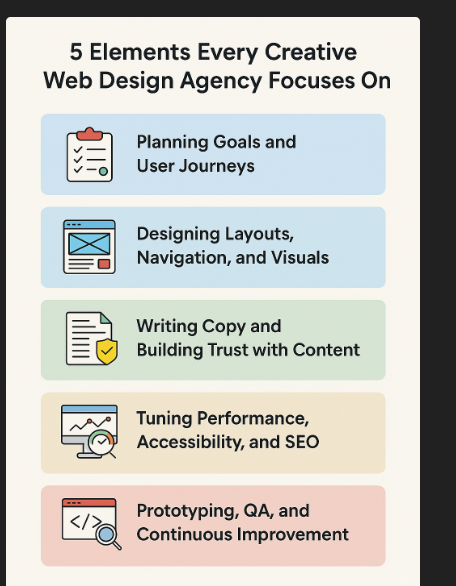
5 Elements Every Creative Web Design Agency Focuses On
When you land on a great website, everything feels smooth, clear, and friendly.
- You know where to click.
- You know what to read first.
- You know how to take the next step without stress.
That feeling does not happen by luck. A creative web design agency builds that feeling by focusing on a tight set of elements that guide every decision, from the first sketch to the final launch.
This article walks with you through the five elements that matter most. You will see how each one helps people find answers faster, trust the brand more, and enjoy the visit enough to come back again.
You will receive practical tips that you can use right away, whether you plan a new site or update the one you already have.
Let’s start strong and then grow the details with care.
Source:Chatgpt
1. Planning Goals and User Journeys
A strong website starts with clear goals and a kind plan for real people. A creative web design agency begins by asking direct questions that set direction and remove guesswork.
- What must this site do first: teach, sell, or support?
- Who will use it most: new visitors, repeat buyers, or partners?
- What actions matter most: reading, signing up, or checking out?
Source: eComstrive
The team turns the answers into simple user journeys that map steps from entry to success. They keep the path short, remove friction, and make every step obvious.
The plan covers pages, features, and content types, and it sets how success will be checked after launch. It also shapes the tone, the layout, and even the photos you choose later.
To make the plan easy to follow, teams often write quick briefs, build low-fidelity wireframes, and list a short set of must-haves. Those tools keep everyone honest and on track.
Tips:
- Set one primary goal for the site and two helpful secondary goals.
- Write three user stories that say who the visitor is, what they need, and why it matters.
- List five tasks people should complete in two clicks or fewer.
- Choose two or three metrics that show real value, like sign-ups or support tickets solved.
2. Designing Layouts, Navigation, and Visuals
Once the plan feels steady, the agency shapes what visitors see and how they move. Layouts give order to the page. Visual hierarchy directs the eyes to the most significant element first, followed by the second element and all other elements.
Designers get attention through size, spacing, and color. The large and bold headlines, the breathing sections with even margins, and the action buttons do not scream.
Tips:
- Keep the main nav under seven items and use short, friendly labels.
- Put the primary button above the fold and repeat it near the natural stopping point.
- Use consistent spacing steps to make scanning easier and reading calmer.
- Limit color accents to key actions so the page never fights itself.
A creative web design agency builds a simple system that includes a color palette, two font families, and a style for photos or illustrations. The system keeps the site consistent across pages and devices.
It also helps new pages launch faster because you do not start from zero. Motion adds clarity when used with care. Small hover states explain what is clickable. Short micro-interactions confirm success after a form is sent. Loaders show progress during waits, but they never stall the action.
3. Writing Copy and Building Trust with Content
Words carry the weight of the site. A creative web design agency writes copy that sounds like a helpful guide, not a loud ad.
The tone remains amiable, the verbs remain active, and the sentences bear a single idea. Headlines represent the big idea, subheads provide the details required, and short paragraphs accommodate the eyes that are in a hurry.
Calls to action tell people what they get, not what the brand wants. “Get your free plan” reads clearer than “Submit form.”
Product or service pages use a simple structure: problem, solution, proof, and next step. Blogs, guides, and FAQs support this structure with answers that solve common issues and lead back to key actions.
Tips:
- Start each page with one clear promise that says how life gets better.
- Use bullets for lists, tables for specs, and bold for helpful highlights only.
- Add proof with short case stories, real numbers, and plain quotes from real users.
- End each section with a next step that feels natural and low risk.
4. Tuning Performance, Accessibility, and SEO Practices
Speed and reach turn good design into real results. A creative web design agency treats performance like a core feature, not a bonus.
The team reduces image sizes, delays scripts that can wait, and removes code that adds weight without value. They choose modern file formats, set browser caching, and serve pages from a trusted content delivery network.
Strong speed helps every visitor and also helps search engines rank the site fairly.
Tips:
- Use next-gen formats and intelligent compression to keep image sizes small.
- Import only the scripts that you are using and postpone the others.
- Apply descriptive and clear titles and meta descriptions that are relevant to pages.
- Create clear headings, which are in a straightforward sequence, H1-H3 or H4.
Accessibility turns a site from usable to welcoming. The agency tests with keyboard navigation, checks color contrast, and adds labels to form fields. They write alt text that explains purpose, not just appearance. They avoid flashing effects and set motion to reduce when a user prefers less movement.
The team measures user signals after launch. They watch time on page, task completion, and bounce rate. They use heatmaps and session replays to spot sticky points. They test one change at a time with A/B trials, so they learn what truly helps.
5. Prototyping, QA, and Continuous Improvement
Before and after launch, careful testing protects the experience you worked so hard to design. A creative web design agency treats testing as a habit, not a phase.
Clickable prototypes help teams spot issues early. Usability tests with five to seven real users reveal confusing labels, missing feedback, and slow steps. Pre-launch QA checks links, forms, states, and edge cases on common browsers and devices. Post-launch monitors watch uptime, speed, and errors so fixes land before users feel pain.
Tips:
- Conduct fast task-based tests on prototypes and document areas of hesitation by people.
- Have a pre-launch checklist: links, form, 404s, titles/meta, sitemaps, redirects.
- Monitor a limited number of health indicators in a period of one week (Core Web Vitals, error rates, conversions).
- Arrange a quarterly clean-up to eliminate old pages and narrow internal links.
Conclusion
You have now understood the five components that drive a creative web design agency like Tangence in planning objectives and paths, developing layouts and navigation, creating images that reinforce the brand, ensuring accessibility, and optimizing for search engine optimization.
One element complements the other, resulting in a site that is visually appealing, engaging to read, and enjoyable to navigate. Begin with a plan, maintain a concise user path, and let the message guide the design.
Provide actual evidence, use honest language, and quantify outcomes using simple numbers that align with your objectives. One little habit that makes you keep your message narrow and your pages clean.